Jesus’ words in Luke 21:5-20 are rooted in a very particular moment: he stands in the temple during his final week, addressing people who can see the stones and splendor of that building with their own eyes. He warns them that what they admire will not stand. The question the people ask is simple and immediate: when will this happen, and what signs will show that it is near?
Outline
- The setting: Jesus in the temple during his final week
- What “these things” actually refers to
- Signs indicating the temple’s destruction
- Prophetic counsel for those who will be persecuted
- The siege and the command to flee
- Interpretation and application for today
The setting and the question
Jesus is in Jerusalem, in the temple courts, preaching his final public message to the nation. He had already wept over the city at his entry and warned of judgment for covenant breaking. Now, when someone points out the temple’s beauty, Jesus delivers a shocking sentence:
“”These things which you see, the days will come in which not one stone shall be left upon another that shall not be thrown down.””
The people ask, “When will these things be? What will be the sign that this is about to happen?” They are asking about the destruction of the temple they can see, not about distant end-time scenarios. The grammar and context point to a near demonstrative: this generation, those standing before Jesus, will see the fulfillment.
What “these things” refers to
Context matters. Jesus had just spoken of the temple and of God’s impending judgment on the nation that had long rejected his prophets. When the audience asks for a sign, the obvious referent is the temple’s destruction. The Lord answers that question directly and gives signs that would mark the period leading up to that event.
Signs indicating the destruction
Jesus lists several signs. Read in their immediate context these are not vague or remote images; they describe the climate of the first century in Judea between the ascension and AD 70. Broadly they are:
- False messiahs and deception. Many came claiming deliverance and divine authority. Historically this happened in the decades around Christ’s life and after. These figures stirred crowds and often led revolts against Rome.
- Wars and tumults. Jesus warns of nations and kingdoms rising against one another. The first century saw repeated unrest and, ultimately, the Jewish revolt that began in AD 66.
- Earthquakes, famines, pestilence, and fearful signs. Contemporary historians and the New Testament record earthquakes, food shortages, and pestilences that befell the region in that era.
- Persecution of the disciples. Believers will be arrested, tried, and sometimes killed. This persecution is both a sign and an experience the early church faced as recorded in Acts and in later Roman repression.
All of these signs appear in the first-century record. Josephus, the Jewish-Roman historian, records unusual portents and social upheavals before and during the revolt. The archaeological and historical evidence lines up with Jesus’ warnings.
Persecution and preparation
When Jesus speaks of being delivered to synagogues, prisons, and rulers he is preparing his followers for what will come. This is not idle prophecy. It is pastoral counsel meant to fortify those who will be tested. A few practical notes emerge from his words:
- Expect opposition even from family and neighbors when ultimate allegiance to Christ is involved.
- Do not worry in advance about what you will say. Jesus promises a mouth and wisdom in the moment of testimony.
- Persecution may be costly. Yet even in suffering God often uses that witness to advance his purposes.
The siege and the command to flee
Jesus singles out one unmistakable sign: when you see Jerusalem surrounded by armies, then know that desolation is near. At that point his instruction is simple and urgent: get out of the city and flee to the mountains. This counsel makes sense only if the destruction is an imminent, local catastrophe. It is not an instruction for the far future or for a cosmic final judgment.
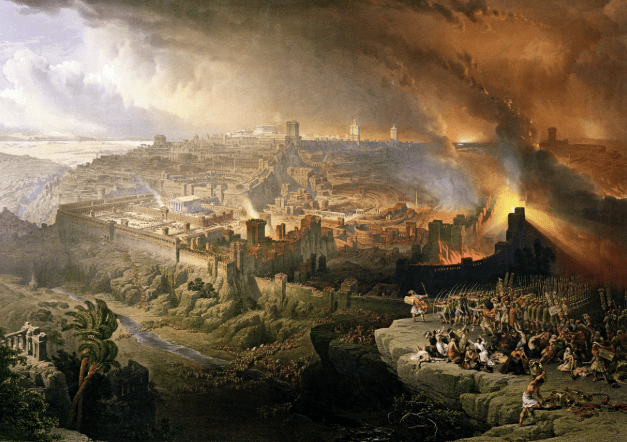
History records that Roman legions, under Titus, laid siege to Jerusalem during Passover season in AD 70. The temple and much of the city were destroyed. Many Christians who heeded warnings and left the city survived. The event fulfilled Jesus’ prophecy in a tragic but precise way.
How should we read this prophecy?
There are two key interpretive moves to keep in mind.
- Read the passage in its immediate context. The audience, the location, the questions asked, and the pronouns used all point to a prophecy directed at Jesus’ contemporaries and the events that would unfold in that generation.
- Harmonize Scripture with history. When we compare the prophecy with first-century records and with the New Testament accounts in Acts and the Gospels, the fit is strong. Josephus and other sources record many of the signs Jesus mentions.
Application
Two pastoral takeaways matter for us today.
- Jesus’ words can be trusted. He foretold events that were fulfilled in history. That reinforces confidence in his prophetic voice and in the reliability of Scripture.
- Learn how to suffer and witness wisely. The counsel Jesus gave his disciples amid coming violence is instructive. When faith brings persecution, stand ready to testify, rely on the Spirit for wisdom, and remember that God is still sovereign over events.
Closing reflection
The destruction of the temple is not merely a historical footnote. It is a sobering reminder of the moral seriousness of covenant infidelity and of God’s righteous response to prolonged rejection. At the same time it shows God’s providence: even wicked deeds and tragic events are used by him to accomplish his purposes.
We are called to live under the authority of the King who spoke truth into history. Let that shape how we trust his promises and how we bear witness in times of trial.
Further reading
- Luke 21 in the Gospels for the full discourse
- Josephus, The Jewish War, for a contemporary historical account of the revolt and the siege
- Acts, for early church responses to persecution and testimony before rulers
 Grace Reformed Baptist Church