Introduction
When Jesus spoke about the destruction of the temple and the fall of Jerusalem he did not speak in vague, far-off terms. He gave a set of signs, a clear warning, and practical counsel to those who would listen. The phrase that arrests us is stark and direct: these be the days of vengeance . That language draws us back to Old Testament prophecy, to Daniel’s seventy weeks, and to a concrete historical fulfilment in the first century—culminating in the catastrophe of 70 AD. The point is not sensationalism; it is sober theology: sin has consequences, God rules history, and the gospel carries both mercy and urgency.
What Jesus Predicted
Standing in the temple the disciples admired its beauty. Jesus answered plainly: that temple would be destroyed—“not one stone left upon another.” The disciples asked when. Jesus answered with signs and a timetable that made sense to his contemporaries. He connected the destruction to the generation before him. He tied the event to Old Testament prophecy and gave pastoral instructions for how his followers should respond.
Key elements of his prediction
- The temple and city would face complete desolation.
- The surrounding of Jerusalem by armies is the decisive sign that the siege and destruction are near.
- Christ calls these events “the days of vengeance” because they are God’s righteous response to long-standing rebellion.
- When the signs begin, Christians are to flee—go to the mountains, avoid the city, preserve life and witness.
“These Be the Days of Vengeance” — What Does It Mean?
The phrase points back to Old Testament prophetic material most notably found in Daniel. Daniel 9 speaks of seventy weeks appointed for Israel—an unfolding of events that includes the Messiah being cut off and the city and sanctuary being destroyed by “the people of the prince.” Jesus is connecting his words to that framework: Israel’s long pattern of rebellion, climaxing in the rejection and killing of the Messiah, brings an appointed judgment.
Daniel’s seventy-weeks schema has three movements: the culmination of Israel’s transgression, the cutting off of the Messiah, and the destruction of the city and sanctuary. Jesus reads those movements forward into his own generation. The foreign armies that come—Roman legions under Vespasian and Titus—are the instrument by which the city’s desolation is carried out.
The abomination of desolation — how to understand it here
“Abomination of desolation” language in Daniel and Matthew can sound mysterious. In this context it is not primarily a future temple ritual performed by a distant figure; it can be understood as the horror that preceded and accompanied the final siege—the internal lawlessness, factional slaughter, and bloodshed that profaned the temple courts. Contemporary historical records show that civil strife inside Jerusalem, with fratricidal violence, slaughter of priests and worshippers, and pools of blood in the temple courts, created a scene of spiritual and moral pollution that matched the prophetic language. That internal corruption made the city ripe for judgment.
Signs: Sun, Moon, Stars, and the Coming of the Son of Man
The cosmic language in Luke 21—signs in the sun, moon and stars; the powers of heaven shaken; the Son of Man coming in clouds with power and great glory—reads like end-times imagery. But the Old Testament prophets routinely used that kind of language for national judgment. Isaiah describes the darkness of sun and moon and the falling of stars when nations are punished. Joel uses the same imagery and links it with salvation for those who call on the Lord. The early church applies Joel to the outpouring of the Spirit at Pentecost.
Interpreting the heavenly signs literally produces a puzzling question: if the sun and moon truly go dark and the stars fall, what good would flight to the mountains do? The more coherent reading is that these are prophetic, symbolic ways to describe decisive acts of God in history—visible, terrifying, world-shaking to those who live through them, but not necessarily cosmic annihilation.
“Coming on the clouds” — a motif of judgment
“They shall see the Son of Man coming in a cloud” is language the prophets used to depict divine presence and judgment. Jesus uses that motif to indicate an arrival of his authority and vindication in judgment. The New Testament applies “coming in clouds” not only to the final consummation but to moments when Christ executes judgment or vindicates his people in history. In the events surrounding 70 AD the church saw a vindication of Jesus’ words and a decisive end to the old covenant temple system.
The Historical Fulfilment: 66–70 AD
The broad strokes of history match the prophecy in chilling detail.
- Rebellion in Judea erupted in 66 AD.
- Vespasian, then Titus, marshalled Roman legions—estimates around 60,000 troops—to suppress the revolt.
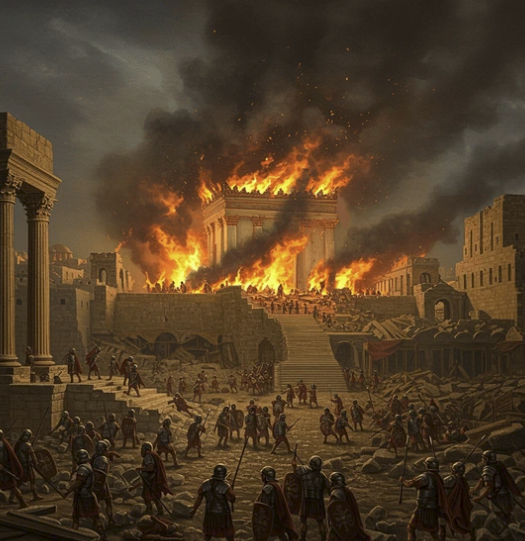
- Jerusalem was besieged beginning April 14, AD 70; the final fall came in September of the same year after months of famine, internecine slaughter and horror inside the city.
- Contemporary accounts record civil factions slaughtering thousands within Jerusalem before the Romans even breached the walls. Josephus and other sources describe famine, cannibalism, priests and worshippers killed in the temple courts, and a city so dismantled that a stranger would scarcely know it had ever been inhabited.
The details are gruesome but instructive. The three calamities Jesus mentions were realized:
- Many fell by the sword.
- Survivors were taken captive and scattered among the nations.
- Jerusalem and the temple were trampled and leveled by Gentile forces until the “times of the Gentiles” were fulfilled.
Practical Counsel: Flee, Watch, and Pray
Jesus does not stop at prophecy and theology. He gives practical counsel to his disciples for when the signs begin to appear.
- Flee to the mountains —get out of the city when armies surround Jerusalem. Historical evidence shows Christians heeded this warning and found refuge outside the city.
- Do not be weighed down —avoid the drunkenness, carousing and divided cares that blunt spiritual discernment. The “heart” here refers to the mind and focus; let it not be distracted so that you miss God’s warning and fail to act.
- Watch and pray —be alert so you may be counted worthy to escape these things and to stand before the Son of Man. Spiritual preparedness is both a moral and practical posture.
Why 70 AD Matters for Redemptive History
70 AD is not merely an historical footnote. It marks a hinge in redemptive history. The old covenant sacrificial system had pointed to Christ; at the cross the reality was secured. The temple’s destruction signaled the end of the old covenant temple system as the central means of atonement and worship. The new covenant, inaugurated in Christ’s blood, moves center stage.
By 70 AD the New Testament writings were largely circulated, the apostles had laid the foundation, and the church was expanding beyond national Israel. The destruction of the temple thus functions as a historical confirmation that the kingdom had arrived and that God’s purposes were proceeding toward their Messianic fulfilment.
Applications: Judgment, Mercy, and Gospel Urgency
Several imperatives press upon us from this episode.
God judges nations and people
If God did not spare his own chosen people for their persistent sin and rejection of the Messiah, no nation is exempt from divine judgment. Privilege multiplies responsibility. A church or nation that receives much light but refuses repentance risks much fiercer judgment.
The gospel is urgent
Christ’s warning is pastoral and missionary at once. To love one’s country is to call its people to repentance, to warn them of the consequences of rejection, and to proclaim the only means of escape: Christ’s free offer of grace. The appropriate patriotic act is not uncritical loyalty but sacrificial witness for the gospel so that our neighbors do not taste God’s righteous wrath but instead receive mercy through faith.
Prophecy confirms God’s control
Prophecy is not a game for seers; it is a demonstration that God governs history. The precise fulfilment of Jesus’ words about the temple and the city is an assurance that his promises—both blessing and judgment—are trustworthy.
Conclusion
The teaching about the days of vengeance invites sober reflection. It reminds us of the cost of covenantal rebellion, the certainty of God’s righteous government of history, and the pastoral urgency of gospel proclamation. When God’s warnings are ignored, calamity follows. When his people heed his word, life and witness are preserved.
So the present duty is clear: proclaim the gospel boldly, call the nation and neighbors to repentance, and live in watchful prayer. The same God who executed justice in those days remains sovereign now. Let that truth shape how we speak, who we love, and what we urgently—tenderly—offer to our friends and family: the saving name of Jesus Christ.
 Grace Reformed Baptist Church