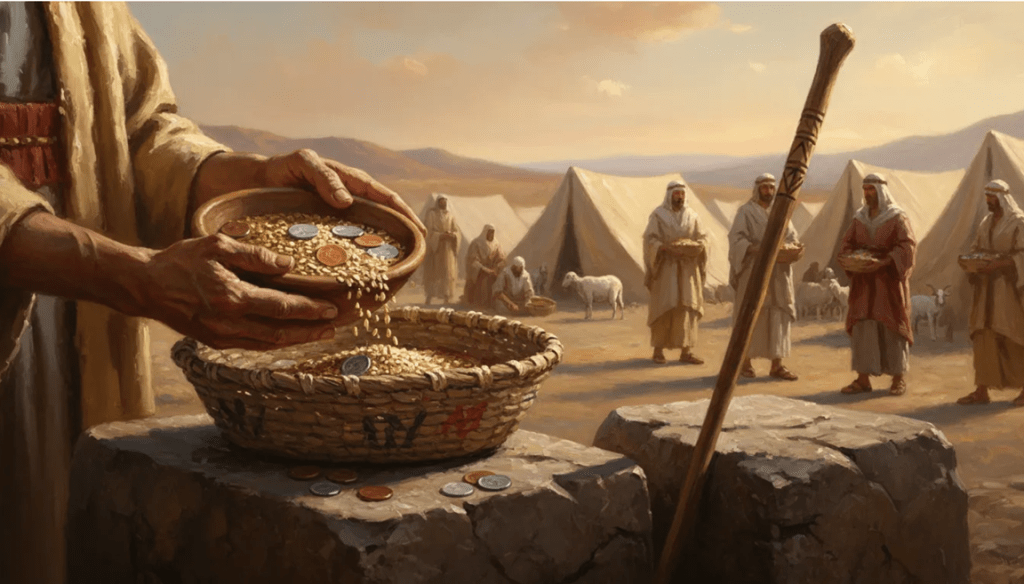
The tithe law is not a relic of an agricultural past to be filed away with the rest of ancient ceremony. It is a deliberate, emphatic command that shapes how a people acknowledge God as owner and provider. The tithe law confronts our assumptions about money, tests our allegiance, and orders the church’s life so ministers and the needy are cared for. This is not abstract theology; it is practical worship translated into how we use what God entrusts to us.
Roots: Before Moses—Abraham and Jacob
When we trace the roots of the tithe law, the trail begins before Sinai. Abraham gave a tenth to Melchizedek after the battle (Genesis 14), and Jacob promised a tenth after his night vision (Genesis 28). These acts show that giving a tenth is older than Mosaic legislation and tied to faith and recognition of God’s blessing.
Those patriarchal tithes were not mere ritual. They were acts of worship and public testimony: God is the provider; we return to him a portion of his bounty. That theological logic undergirds the later, statutory form of the tithe.
Deuteronomy 14: The Command and Calculation
Moses states the rule plainly: thou shalt surely tithe the increase of the seed of the field year by year. The Hebrew idiom intensifies the command—this is not optional or casual. The tithe applies to the whole product, the yield God grants, and it is to be calculated regularly.
Note two basic points: first, the tithe is a covenantal obligation. It is statute law rather than a case-by-case judgment. Second, the tithe is proportional—a tenth—so giving is tied to increase; as God prospers, our devotion and recognition of his ownership should rise accordingly.
Why the phrasing “the field” matters
Moses speaks of “the field” rather than “your field.” The reminder is plain: the land, the increase, the very provision belong to the Lord. The tithe is a tribute, an acknowledgment that we are tenants on God’s estate.
The Purpose: Worship, Support, and Thanksgiving
The tithe performs several related functions. It is first and foremost an act of worship—an offering presented at the sanctuary. Part of the tithe was eaten as a celebratory meal before the Lord, a harvest thanksgiving that reminded Israel that Yahweh, not Baal, supplied the increase.
Second, the tithe was appointed for the support of the Levites who had no land inheritance but served the people in teaching, worship, and justice. Numbers 18 frames the tithe as provision for God’s ministers. The tithe law, then, secures both the place of worship and the people who serve there.
““Will a man rob God? Yet ye have robbed me. But ye say, In what way have we robbed thee? In tithes and offerings.” — Malachi 3:8 (KJV)”
Malachi’s rebuke is severe because withholding the tithe is a violation of covenant loyalty. God treats such neglect as theft—an assault on his rightful claim and the practical means for his work to be carried out.
Practicalities in Deuteronomy: Converting Produce and Regularity
Deuteronomy anticipated logistical difficulties. If carrying grain, oil, or wine to the sanctuary was impractical, the law allowed conversion to money equivalent. That instruction shows the law’s realism: the tithe is about rightful tribute and worship, not unnecessary hardship.
Two practical rules translate well to our setting: the tithe must be carefully calculated (on increase and profits) and paid at regular intervals (aligned with harvest or income cycles). For wage earners, this is simple; for business owners, the tithe is due on profits when accounts are settled.
Third-Year Provision: Levites and the Needy
Every third year the tithe had a special emphasis: a portion was stored locally to feed Levites who lived among the people and to provide for strangers, orphans, and widows. This was not welfare as an abstract program; it was a covenantal safety net that kept ministers in place and cared for the truly destitute.
Applied today, the intent remains: the church’s resources should sustain those who preach and teach the gospel and address genuine, chronic need with wisdom. Families are primary carers; the church complements where family fails, exercising prudent oversight rather than indiscriminate handouts.
New Testament Continuity
The tithe law’s moral logic carries forward into the New Testament. Jesus affirms tithing when he rebukes religious leaders for scrupulous outward giving while neglecting “weightier matters” such as justice and mercy—he insists both matter. Paul reasons similarly: those who preach the gospel should live by the gospel (1 Corinthians 9). Hebrews points back to Abraham’s tithe to Melchizedek as a type that enriches our understanding of Christ’s priesthood.
So while the precise ceremonial prescriptions tied to Israel’s cultic life need not be copied literally, the tithe law’s principles—regular, proportional giving; support for ministers; and care for the needy—are morally binding on the church.
How to Practice the Tithe Law Today
- Start with the tenth. The tithe is the minimum, a starting point for proportionate, joyful giving.
- Calculate carefully. Tithe the increase—wages, profits, commissions—on a regular schedule that matches your income cycle.
- Pay the ministers. Ensure pastors and teachers are provided for so they can serve without undue financial strain.
- Care for the needy wisely. Prioritize family responsibility, then church charity with accountability to prevent enabling sin.
- See giving as worship. Bring gladness and thanksgiving to the act; it is a testimony that God is provider, not you.
A Clear Call
If your heart bristles at the idea of being told how to give, consider whether you see your money as yours or God’s. The tithe law is a covenantal test: are you willing to obey and recognize the Lord’s ownership? If finances are strained, blaming circumstances misses the heart of the matter. Radical trust and disciplined stewardship often re-order what seems impossible.
Do not let pride or poor theology keep you from this simple obedience. The tithe law is not a burden meant to impoverish worship leaders; it is a structure by which God’s work is sustained and his people learned to fear and thank him.
Final Encouragement
Repent where needed, bring your tenth with thanksgiving, and participate in the church’s work so you know how your gifts are used. Give joyfully and prudently; support those who serve; help the helpless with wisdom. The tithe law will teach you a better way to handle money: it is God’s resource entrusted to our stewardship for his glory and the good of his people.
Tithe law is not a cold tax; it is a covenantal practice that forms worship, supports ministry, and shows mercy. Live it as such.
Full Sermon – https://youtu.be/VaSakOBe0vU
 Grace Reformed Baptist Church