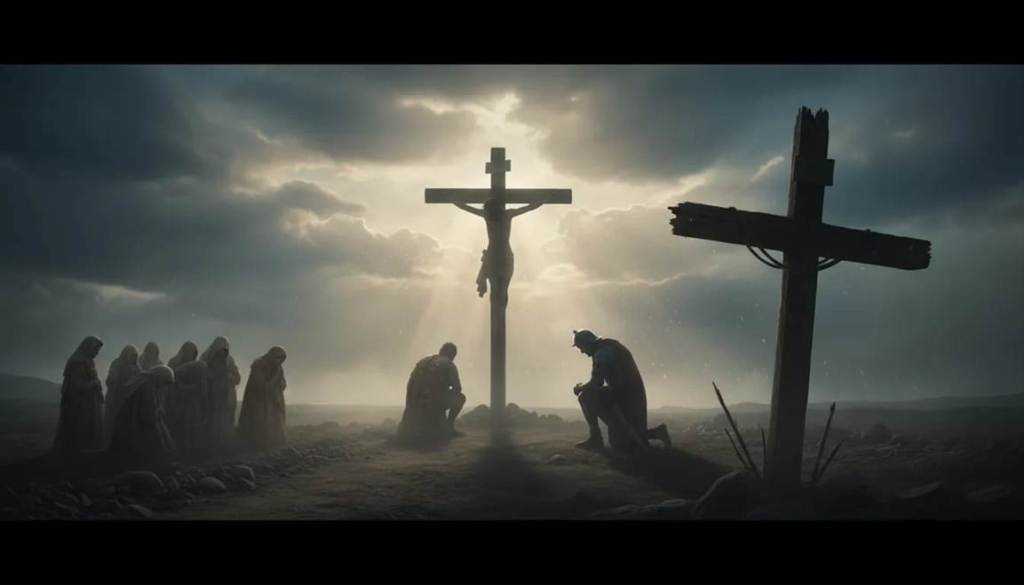
If the cross has become “ordinary” in your mind, Luke 23 is meant to take the lid off that familiarity. Not by overwhelming you with new facts, but by reintroducing you to what is holy, heavy, and glorious. This section of Luke gives us the historical account of Jesus’ crucifixion and death, and it does something else too: it keeps insisting that Christ’s death was never merely tragic. It was purposeful, theological, and deeply personal.
In Luke 23, you do not just watch Jesus suffer. You watch how He speaks, how He prays, and how His approach to death reaches people who seem least likely to respond: a man who is forced to carry the cross, women mourning along the road, a hardened criminal, and even a Roman centurion.
First, Come to Luke 23 With Reverence (Because It Is Holy Ground)
There is a danger in familiar theology. We may say the right phrases, “Jesus died for my sins,” and then live as if the cross has no practical claim on our daily attention. The issue is not that Christians know the cross; the issue is that we can treat it as background noise.
Luke 23 is holy ground. God’s plan of redemption is not casual, improvised, or cheap. The Lord of glory did what He did for sinners at a real cost. If you come with a nonchalant attitude, Luke’s message presses you to repent of that posture and return to awe.
Isaiah 53 Interprets the Cross: Why Christ “Is Satisfied”
One of the striking things about the Gospels is that they record the crucifixion, but they do not merely “explain it” in a standalone way. They assume that Scripture interprets Scripture. The Old Testament is constantly pointing ahead to what happens when Christ is lifted up.
Isaiah 53 is a direct lens for the cross. Isaiah says the Servant is wounded for transgressions, bruised for iniquities, and that by His stripes God provides healing. It is not abstract. It connects the Servant’s suffering to real sin and real deliverance.
And here is the heart of it: Isaiah also tells us the “one who was struck” will be satisfied. Why will Christ be satisfied? Because the ones He came to die for will be saved. Christ’s satisfaction depends on the effect of His atonement.
There is no satisfaction in Christ if His death is aimed at people and then fails to save them. The whole biblical storyline, especially the sacrificial system, is pointing toward a substitutionary sacrifice that actually accomplishes what it was designed to do.
Atonement Was Built Into the Bible’s World: Day of Atonement and Romans 5
To understand why the cross had to happen, you can’t start with human imagination. You start with God’s established pattern.
Leviticus 16: The Shape of Atonement
On the Day of Atonement, the high priest made atonement for the holy place because of Israel’s uncleanness and transgressions, and for all sins. The important point is that the sacrifice was tied to real uncleanness and real guilt.
Romans 5: God Demonstrates Love in the Place of Sinners
Romans 5 then explains the logic: God demonstrates His love by Christ dying while we were still sinners. The cross is not God “reacting” to a people who earned His favor. It is God acting in love toward enemies, reconciling through the death of His Son.
So when Luke brings you to the crucifixion, you are not only reading history. You are seeing the fulfillment of a story God set in motion, page after page, in prophecy and typology.
The Road to Calvary: How Jesus Gets to the Cross
Luke 23 begins with the road to Calvary, verses 26 to 32. After Jesus is sentenced, the soldiers lead Him away.
Along the way they lay the cross on a man named Simon, a Cyrenian (from Cyrene). Simon is coming from the country, likely a devout Jew who had traveled for the Passover. Imagine planning a worship trip and suddenly being interrupted by the cruelty of Roman execution.
Jesus is exhausted. Something has already been done to Him before the walk begins. Luke itself does not linger on every detail, but the bigger point remains: the sinless Son of God is being driven toward death after intense suffering.
Simon’s Cross Becomes a Turning Point
There is also a memorable detail that connects Simon to later discipleship. Mark tells us Simon is the father of Alexander and Rufus. That suggests a known Christian connection in the early church. Tradition even indicates Simon himself may have become a believer after this event.
The idea is powerful: some people do not drift away from Christ because of what the cross seems to represent. Some people are brought to Him.
Daughters of Jerusalem: Jesus Does Not “Just” Comfort. He Warns
Luke is unique here. As Jesus walks, there are women mourning and wailing. Their grief is real. It is also misguided in the direction of its focus.
Jesus turns to them and says, “Daughters of Jerusalem, do not weep for me, but weep for yourselves and for your children.”
His warning is severe. He describes a coming time when people will treat the absence of children as a kind of cursed relief: “Blessed are the barren.” In biblical thinking, fruitfulness is a blessing, so this reversal must be understood as judgment language.
Then Jesus adds another image: people will wish for death to come quickly, calling for mountains to fall on them. He even ties the warning to what earlier prophets had foretold.
Hosea and the “Cover Us” Cry: Judgment Language in Luke 23
Jesus echoes the prophetic pattern from Hosea. When judgment comes, people cry out to mountains and hills to cover them.
Don’t miss this point – it is not merely “God hates idolatry” in a general sense. It is that idolatry produces real moral collapse, real persecution, and real divine judgment. Christians should not assume idolatry only happens in obviously pagan contexts. Even religious traditions can become distractions that pull attention away from what God is doing.
Judgment is coming on hardened rejection. And in Luke’s flow, Jesus is already interpreting what the cross means for Jerusalem: the Messiah is rejected, and therefore judgment follows.
“Greenwood” and “Dry”: What Happens When Injustice Is Already Possible?
After warning the women, Jesus says something that sounds oddly specific: “For if they do these things in the greenwood, what will be done in the dry?”
Two interpretive angles are proposed:
- Israel-focused interpretation: If corrupt religious and civil authorities can override justice and execute an innocent man in a relatively stable environment, what happens when morality and restraints are gone?
- Roman-focused interpretation (the speaker leans here): If Roman authorities kill an innocent Jew like Jesus during a relatively peaceful time, what will they do when conflict rises and Israel revolts?
Either way, the warning presses one theme: once injustice becomes thinkable in “greenwood” conditions, “dry” conditions will make it inevitable. The severity does not start from nowhere. It grows out of already-accepted corruption.
The Cross Itself: Calvary, Crucifixion, and the Scandal of Christianity
Luke moves from the road to the place of execution. Jesus is led to Calvary, a term associated with “skull” imagery. The location is outside the city, a place where shame is part of the punishment.
Luke says they crucified Him along with two criminals. Roman crucifixion was designed to be merciless. It was humiliating, public, and torturous.
Why Crucifixion Was Extra Scandalous to First-Century Jews and Greeks
For Jews, a cross carried curse language (Deuteronomy 21:23). For Greeks, the Messiah dying on a cross looked like foolishness. Early Christians still preached Christ crucified anyway, not because the execution was beautiful, but because God used it to redeem.
The scandal is part of the point: Christianity does not depend on religious respectability. It depends on God’s truth and His saving work.
“Father, Forgive Them”: Who Does Jesus Pray For?
Luke records Jesus’ prayer from the cross: “Father, forgive them, for they do not know what they do.”
The important discussion here is not to blur forgiveness into something vague. Understand that the prayer cannot mean “everyone involved is ignorant in the same way.” Some rejected Jesus knowingly. Some opposed the Messiah based on a deliberate twisting of truth.
So who is the “them” in view? Jesus is praying for those like the Roman soldiers who acted without grasping the identity and righteousness of Christ.
That still does not excuse sin. It highlights a distinction the Gospels also make: there is a difference between sin committed in ignorance and rebellion committed in full awareness.
Mockery, Rulers, Soldiers, and the Two Criminals
Jesus is mocked. The rulers sneer that He saved others, so they demand He save Himself. Soldiers mock Him with sour wine and the challenge: if He is king of the Jews, let Him prove it.
Meanwhile, the criminals also join in. One hurls insults at Jesus and asks for self-rescue.
But then the tone changes. Another criminal rebukes the mocking one and makes a spiritually piercing observation: do you not even fear God, now that you are under the same condemnation?
And he adds that Jesus has done nothing wrong. That confession matters. The man on the cross recognizes both his own deserved judgment and Jesus’ innocence.
The Dying Thief’s Faith: “Lord, Remember Me”
One of the most moving moments in Luke 23 is the request of the repentant thief. He does not command Jesus. He cries out to Him as Lord and asks, “Remember me when You come into Your kingdom.”
Jesus answers immediately: “Today you will be with me in paradise.”
Paradise Means Presence With Jesus
The word “paradise” evokes the garden imagery found in Scripture. The implication is clear: Jesus restores what sin broke. He brings people into a state that echoes Eden, and the defining feature is not location but being with Him.
Pastoral point: if you do not enjoy being with Jesus now, you will not enjoy heaven. Paradise is paradise because Jesus is there.
Three Hours of Darkness and the Torn Temple Veil
Luke shifts to a striking sequence. From about the sixth hour, darkness covers the land until the ninth hour. The sun is darkened, and the veil of the temple is torn in two.
There is connection to biblical “touchable darkness” in Egypt, linking darkness to curse and judgment. The claim is that during these hours Christ bears sin and undergirds the curse of sin through His death.
Luke also does not delay on interpretation: the tearing of the veil signals that the old covenant system is no longer the only path to God’s holy presence. Hebrews is brought in as the interpretive framework: access is opened through Christ.
“It Is Finished”: Payment in Full, Not Endless Sacrifice
Jesus then cries out with a loud voice and commits His spirit to the Father. His final statement, “It is finished,” carries the sense of debt being paid in full, like a receipt marked complete.
This is used as an argument against any system that repeats sacrifice as though the cross were not truly sufficient. If Christ truly said “paid in full,” then further “payments” would undo the finished work rather than build upon it.
The Centurion’s Confession: “Truly This Man Was Righteous”
Luke notes the response of the centurion. He glorifies God and declares that Jesus is righteous. This is not merely “good person” language. It is the language of righteousness in the fullest sense, tied to justification.
Christ is not only innocent. He is positively righteous. And in justification, believers are not only forgiven. They are also given the righteousness of Christ.
So when God looks at the saved, the claim is that God does not see sins as the defining identity. He sees Christ’s righteousness.
The People Walk Away: Lament, Chest-Beating, and the Question of Repentance
Luke describes the crowd returning “beating their breasts.” That is grief and alarm, but the question remains: is it saving faith or only emotional shock?
Compare this scene to the day of Pentecost, when people were convicted by Peter’s preaching. When they asked what to do to be saved, the key sign was not manipulation or spectacle, but brokenness, repentance, and faith, which is always the sign a work of grace has taken place.
What the Cross Reveals: Prophet, Priest, and King
This chapter on the death of Christ pulls together the roles of Christ that appear throughout Luke.
- Prophet: Jesus warns of coming judgment, speaking in line with Scripture like Hosea.
- Priest: Jesus intercedes, asking the Father to forgive.
- King: Jesus opens the kingdom to the repentant thief, granting entrance “today.”
Christ’s death therefore is not only a sacrifice. It is also a revelation of His authority and mediatorial work.
Four Kinds of People in One Scene: Cross-Shaped Responses
Luke 23 does not only show what happened to Jesus. It also shows how people respond to Christ crucified.
Simon the Cyrenian: the Way of Discipleship
Simon is portrayed as a picture of real discipleship. His willingness to carry the cross suggests a move from forced participation to chosen obedience.
The point is practical: Christian suffering can be ugly. Following Christ can bring out the worst in people around you. That does not mean Christ is discouraged. It means the gospel exposes hearts.
The Roman Soldiers: Hardened Men Can Be Converted
One soldier, even a centurion, can confess Christ’s righteousness. The warning is not to despise hardened people. Preach Christ crucified. Let them see who He is and why He died.
Religious Hypocrites: Garment Without Life
Religious leaders in the story are described as clean on the outside but dead inside. Their opposition to Christ is treated as a warning about religious garb that blocks others from the kingdom.
The Women of Jerusalem: Don’t Make It Sentimental
The wailing women are a picture of a sentimental religious approach. Mourning without repentance can become a pity party rather than a spiritual awakening.
Jesus’ own words matter: He tells the mourners to weep for themselves and for their children. The cross is not primarily an occasion for aesthetic emotion. It is an occasion for sin-acknowledging sorrow and faith in the Savior.
Don’t Distract the Next Generation: Celebrate the Resurrected King
The final application is aimed especially at parents and grandparents. Your children learn what you repeatedly point them toward.
Instead of turning Easter into a feel-good tradition disconnected from Christ, the counsel is to feast on Scripture, sing praises, and explain why the cross and resurrection matter.
Direct challenge: would you rather teach children that the most important event is Christ crucified and Christ risen, or settle for rituals that shift attention away from the living King?
And that is where Luke 23 lands. It is not only about what Jesus endured. It is about what His death accomplished: a way to paradise through faith, the restoration of Eden through the kingdom of the King, and a love so real that it removed the wrath of God from sinners through Christ’s propitiation.
A Closing Invitation: Have You Asked Jesus for Mercy?
Luke 23 presents the same invitation across multiple characters. The repentant thief asks for remembrance in the kingdom. The centurion confesses righteousness. Simon’s cross becomes discipleship. Each one, in their own way, turns from rejection and toward Christ.
The question for you is not whether you can repeat the phrases about the cross. The question is whether your heart is being shaped by it.
If Christ is truly the righteous King who restores paradise through His finished work, then today is not a sentimental pause. It is a day to worship the living King, entrust your children to His Word, and keep preaching Christ crucified until the grave is defeated in your hope too.
For full sermon:https://youtu.be/LAAtVDtSsjw
 Grace Reformed Baptist Church