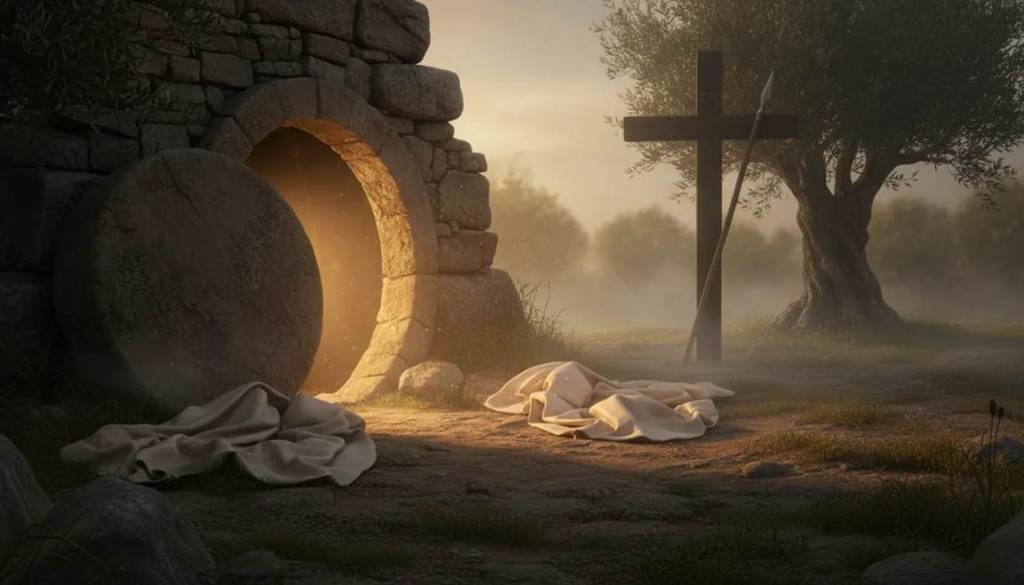
If the Christian faith had one central “anchor point,” it would be this: Jesus is not only alive in some vague spiritual sense. The resurrection is presented in Scripture as a bodily resurrection. A real body was crucified. A real body was washed and wrapped. A real body was laid in a tomb. And that body is gone.
That emphasis matters because the gospel is not merely advice about how to live. It is a historical proclamation about what God has done in Christ.
The Gospel in Four Historical Events (1 Corinthians 15)
Before Luke 24 drives the reader to the empty tomb, Scripture builds the foundation. Paul does something helpful in 1 Corinthians 15: he summarizes the gospel as an apostolic, historical witness.
In 1 Corinthians 15:1-8, Paul says the gospel he preached, the gospel the Corinthians received, and the gospel by which they stand (and by which they are saved) is built around four events:
- Christ died for our sins, according to the Scriptures.
- He was buried.
- He rose again the third day, according to the Scriptures.
- He was seen by many witnesses after the resurrection.
Paul’s point is clear: the gospel is not “new spirituality.” It is a chain of real events, grounded in Scripture, witnessed by people who could be identified.
1) Substitutionary death: “Christ died for our sins”
Paul ties Christ’s death directly to God’s Old Testament promise. The death of Jesus is described as substitutionary because He “died for” sins.
At the time Paul wrote, “according to the Scriptures” would point back primarily to the Old Testament. That includes:
- Prophetic predictions of one who would bear sins
- Typology, especially the sacrificial system, where the direction of the whole Levitical pattern was toward Christ’s work
The logic of the gospel is that Christ did not merely demonstrate courage. He bore the penalty of death for sinners.
2) Burial: proof that a real body really died
Paul doesn’t let the gospel float by without mentioning burial. Why does burial matter? Because you do not bury someone who is alive.
The burial is presented as evidence against denial. There have always been theories that try to detach Jesus from real death. Scripture fights that at a critical point: a real body was laid in the grave.
So even when people want to reduce the cross to “symbolic tragedy” or “spiritual moment,” the biblical witness insists on physical reality.
3) Resurrection “according to the Scriptures”
Paul then says Jesus rose again “the third day,” again according to the Scriptures.
One major Old Testament thread is Psalm 16:8-11, which the apostles connect to the resurrection. The idea is not that God ignored death, but that God vindicated His Messiah. Resurrection is presented as God’s declaration to the world that:
- His Son’s death was accepted
- the sacrificial transaction was complete
- and salvation has been accomplished
In other words, resurrection is not an accidental twist in the story. It is the decisive confirmation of God’s approval.
4) Appearances: eyewitnesses of the risen Lord
Finally, Paul emphasizes that Christ was seen by witnesses. Many eyes saw the resurrected body of Jesus Christ. Paul even points out that at the time of his writing, many of those witnesses were still accessible.
This is why Luke’s account does not feel like it’s floating away into mystery. The gospel includes death, burial, resurrection, and seeing. It is meant to be believed as truth, not merely admired as legend.
Luke 23 and 24: The Burial Scene Is Not a Side Note
With that background in place, Luke moves into the burial of Jesus and then into the empty tomb.
Beginning in Luke 23, Luke introduces a man named Joseph of Arimathea. Luke starts with the word “behold”. That is not “filler.” Luke is telling you to pay attention because something significant is happening that no one should miss.
“Behold”: a surprise step into the crisis
Joseph is not introduced as one of the obvious disciples. He is a council member in Israel, connected to the Sanhedrin that condemned Jesus.
So the timing is striking. While the body of Jesus hangs under Roman custody, many of the disciples are scattered. John records that he remained near the cross, but the others are not standing forward.
Luke highlights Joseph precisely because the burial of Jesus could have gone another direction. Without someone stepping up, the body might have been left to suffer as criminals’ bodies often did: thrown into a common heap or left exposed.
At this moment, Joseph comes forward.
Who Was Joseph of Arimathea?
Luke gives a cluster of descriptions that explain why Joseph matters so much.
He is Jewish and from Arimathea
Luke identifies Joseph as Jewish, from the city of Arimathea.
He is a member of the Sanhedrin
Joseph is a council member, part of the leadership of Israel.
That detail matters because the same group that condemned Jesus is the leadership structure Joseph belongs to. Luke is not ignoring that tension. He is highlighting it.
He is “good and just”
Luke says Joseph is morally upright, and also that he acts for the good of others.
He is not only “good,” but “just” or “righteous.” Luke clarifies that “righteous” does not mean “perfect.” It means his conduct conforms to God’s law.
He did not consent to the condemnation
Luke also makes a careful point: Joseph was on the council, but he did not consent to the condemnation of Jesus. He refused to vote in line with their action.
In the language Luke uses, the idea is that Joseph did not deposit his vote with them. He would not agree to what they were doing.
He was waiting for the kingdom of God
Luke finishes the description by saying Joseph was waiting for the kingdom of God. The word “wait” is closely connected to faith in Scripture. In effect, Joseph trusts God’s promises even while the world looks hostile.
Luke pairs Joseph with other faithful “waiting” figures in his gospel, such as Simeon, who was described in similar terms. These are saints of expectation, not people who only show up once a crisis is over.
Secret to Bold: Why Joseph Didn’t Move Earlier (and Why That Matters)
One question naturally arises: if Joseph is faithful, why is he not openly following Jesus earlier?
Scripture suggests at least one reason. John records that Joseph was a disciple, but he acted secretly “for fear of the Jews.” In that moment, he hid, not because faith was absent, but because courage was delayed.
That is uncomfortable, and it should be. Luke does not pretend faithful people never struggle with fear. Instead, God’s providence can work even through hesitation.
So there is a gentle warning and a hopeful encouragement here:
- It is easy to judge someone for backing down in fear.
- But God may be preparing them, teaching them, shaping them.
- Then, at the right moment, they step up.
Joseph’s “secret” faith becomes public action at the exact time it counts.
Joseph Goes to Pilate: Counting the Cost
Luke says Joseph went to Pilate and begged for the body of Jesus. “Begged” means he earnestly asked.
This was not a small request. Joseph’s action could cost him his place, his honor, and possibly his usefulness. When he approaches Pilate, he is sealing his fate with the Jewish leadership. His earlier caution gives way to covenant courage.
Nicodemus Joins In (Secret Disciples Becoming Providers)
Joseph is not alone. John tells us that Nicodemus also came forward. Both men act like secret disciples when it would have been socially dangerous.
Luke’s burial account then moves with urgency:
- They take Jesus’ body down.
- They prepare it for burial.
- They wrap it in linen according to Jewish custom.
- They lay Him in a tomb.
This is messy, physical work. Luke is not trying to make the death of Jesus “clean and tidy.” A bruised, dead, bloody body must be handled with care, and these men do it anyway.
The Burial Details: Washed, Wrapped, Laid in a Tomb
Luke emphasizes the preparation:
- Washing and anointing with spices would be part of Jewish burial practice.
- Wrapping involved linen strips laid around the body.
- Laying the body in the tomb completes the burial.
The point is not just that Jesus died. The point is that a real body went into the grave.
And the tomb is described as Joseph’s own, likely prepared for himself. Joseph honors Jesus with a costly, personal gift.
Time Pressure: The Day of Preparation and the Sabbath
Luke also notes that this all happened on the day of preparation, with the Sabbath drawing on quickly. The schedule forces rapid action because the burial had to be completed before Sabbath obligations began.
Luke then shows that the women who followed Jesus are present, watching where the body is laid. They plan to come later after the Sabbath to do additional anointing.
That creates a powerful picture of “love that must wait.” Even devotion has a timetable.
The Sabbath Rest and the New Creation
Luke paints the burial and the Sabbath rest like a turning point. It is not just “the end of a tragic week.” It is the quiet pause before the dawn of a new era.
The preacher makes several connections that linger in the mind:
- Jesus rests in the grave, much like God’s completion after creation.
- The new creation is awaiting the dawn of the first day of the week.
- The “second Adam” scene ends with death and burial before resurrection brings life.
The intensity of the trial is over. The body is cared for. And then the waiting begins.
Luke 24: The Tomb Is Empty, and the Resurrection Is Bodily
If Luke 23 is about burial, Luke 24 is about the empty tomb.
The women come early on the first day of the week with spices they had prepared. Their concern is practical. The stone is heavy. How will they push it away?
But when they arrive, the stone is already rolled aside. The tomb is open. Their mission collides with a reality they cannot explain.
Luke’s key emphasis: a bodily resurrection
Luke emphasizes something all the gospels emphasize: this is a bodily resurrection. It is not merely a spiritual experience.
Luke repeatedly points the reader back to the physical details:
- There really was a body crucified.
- There really was a body washed and wrapped.
- There really was a body laid in the tomb.
- And there is now no body there.
So any theology that tries to deny the physical nature of the resurrection ends up denying the gospel itself. Luke wants readers to keep their attention on the body.
Angels interpret the empty tomb
When the women do not find the body, angels appear to them. Their message addresses the confusion directly:
- Why are you seeking the living among the dead?
- Remember what Jesus taught you while you were in Galilee.
- The Son of Man must be delivered, crucified, and rise on the third day.
In Luke’s account, faith is not produced only by empty facts. Faith comes through God’s word interpreted by God’s messengers.
The empty tomb becomes meaningful because Scripture had already predicted the resurrection and Jesus had already taught it.
The women become the first witnesses
The women are sent to tell the disciples what they saw and heard. The disciples initially reject the report. Their response in Luke is sharp.
Still, Luke includes the crucial turning point: Peter gets up and runs to the tomb.
Peter’s Response: Linen Clothes and Astonishment
Peter looks in and sees something spectacular: the linen cloths.
Luke’s details matter. The linen is not scattered around like stolen property tossed in panic. Instead, the wrappings are laid in a way that suggests intentional order.
Peter is amazed. His question shifts from “Where is the body?” to “What kind of resurrection is this?”
Luke’s scene leads to a strong conclusion: the body is gone, but the burial evidence remains.
This undercuts theories that Jesus simply regained consciousness and walked away. If it were only a “swoon,” the wrappings would not be left behind in orderly form.
Luke leaves Peter at the stage of wonder rather than complete confirmation, but later appearances of Jesus provide what Peter could not yet see at that moment.
Why the Resurrection Changes Everything
The conclusion should be obvious, but it is easy to forget: the Christian faith stands or falls with the resurrection.
The Bible presents an image that is simple and hard to dodge: a dead man cannot save other dead men. If Christ had not risen, the gospel would have no saving power.
Romans 1 ties Jesus’ identity as Son of David to being “declared … with power” by “the resurrection from the dead.” Romans 4 then links justification to God raising Jesus: Jesus was delivered for offenses, and believers are justified because God raised Him.
So resurrection is not only a historical claim. It is the foundation of assurance. Christ’s resurrection signals God’s acceptance of the cross.
Celebrating Weekly Because the King Is Risen
This is why Christians gather every week. It is not like false religions that treat sacred figures as dead instructors whose wisdom must be retrieved from the past.
Instead, believers come to worship and hear the risen King speak to His people.
Because Christ lives, we will live also.
Conclusion: Don’t Let the Tomb Be “the End”
Luke does not let the story end at burial. Death is real. Burial is real. But God’s verdict is louder.
So the practical takeaway is not only theological. It is personal:
- Christ’s resurrection defeats death’s final claim.
- That means Christians do not fear death as an ultimate end.
- We may still dislike suffering and the process of dying, but we do not fear separation from Christ forever.
- We look forward to the resurrection of our bodies when Christ returns.
The empty tomb is not a riddle left for speculation. It is a proclamation grounded in Scripture, anchored in history, and centered on a bodily resurrection.
For full sermon: https://youtu.be/DwPjPG9_ZaA
 Grace Reformed Baptist Church