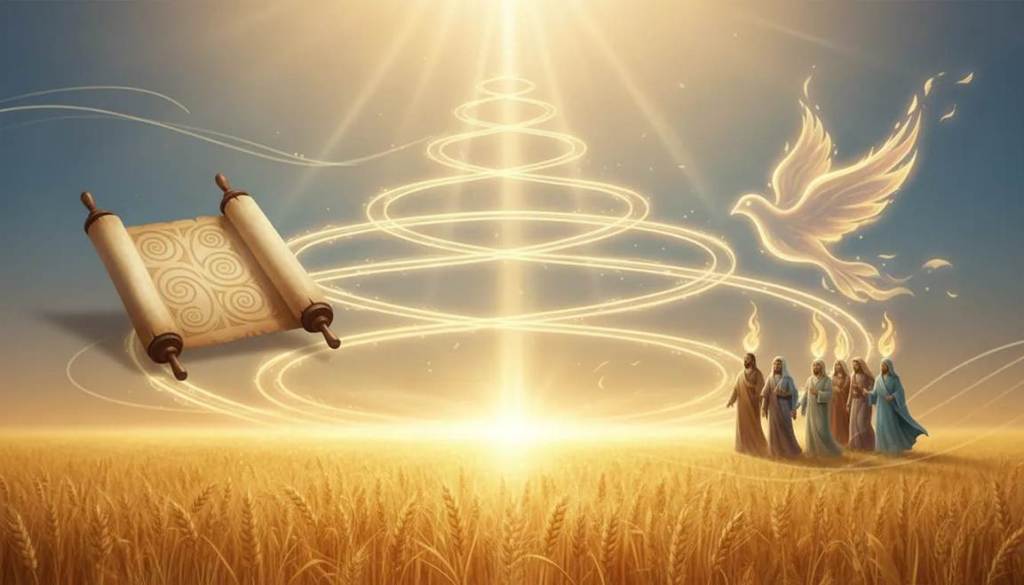
“You shall count seven weeks for yourself.” With that simple command in Deuteronomy 16, Moses opens up one of the richest feasts in Israel’s calendar.
The Feast of Weeks was not an arbitrary religious holiday, and it was not merely a harvest party with some pious decorations added on top. God appointed it to teach His people how to remember, how to rejoice, how to give thanks, how to care for the poor, and ultimately how to understand what He would later accomplish in Christ at Pentecost.
If we read these Old Testament feasts carelessly, we can treat them as little more than ancient Israelite scheduling. But Moses was not filling space. These feasts had design, order, and theological weight. They were shadows, and Christ is the substance. They were appointed signs, and in the New Testament their meaning bursts into full bloom.
The Larger Purpose of Israel’s Feasts
Before narrowing in on the Feast of Weeks, it helps to remember what these annual gatherings were for. The feasts in Deuteronomy 16 were not random celebrations. They were meant to shape the life of the covenant people.
Among other things, these feasts were given for at least seven reasons.
- They were for worship. Israel gathered before God at the central sanctuary to offer sacrifices and gifts.
- They were for remembrance. The people were to remember God’s redemptive acts, especially His deliverance from Egypt.
- They were for thanksgiving. Each feast had an agricultural setting, reminding Israel that God was their provider.
- They were for rejoicing. These were not dour observances. God commanded joy.
- They were for hearing the Word. The people gathered around God’s revelation.
- They were for unity. Scattered tribes were reminded that they were one people under one Lord.
- They were for renewed allegiance. Year by year, Israel came before God to confess again that they belonged to Him.
That is already enough to preach to modern Christians. We are no less prone to forget. We are no less prone to become full, prosperous, distracted, and spiritually dull. God knows our frame. He knows our tendency to drift. So He gave Israel feasts, and He has given us ordinances, worship, prayer, the Lord’s Day, and the fellowship of the saints, all so that we do not become practical atheists while still mouthing orthodox words.
The Various Names of the Feast
One reason people sometimes get tangled up in these feasts is because Scripture uses more than one name for the same observance.
The Feast of Weeks is called:
- The Feast of Harvest in Exodus 23:16
- The Feast of Weeks in Exodus 34:22 and Deuteronomy 16
- The Day of Firstfruits in Numbers 28:26
- Pentecost in the New Testament
That last name comes from the Greek word for fifty. And that leads directly to the next question.
Why It Was Called Pentecost
The Feast of Weeks was a one-day feast, but it was called “Weeks” because of how it was dated. Israel was to count seven weeks from the time associated with the beginning of the grain harvest, specifically from the day after the Sabbath connected to Passover.
Leviticus 23 makes this more explicit. After the Passover Sabbath, on the day when the sheaf of the wave offering was presented, Israel was to begin counting. Seven full weeks were to pass. That brought them to the fiftieth day.
That is Pentecost. The fiftieth day.
So when Acts 2 says that the Spirit was poured out on the day of Pentecost, that is not a throwaway chronological detail. It is loaded with redemptive significance.
The Redemptive-Historical Meaning of the Feast
Passover plainly looked back to Israel’s deliverance from Egypt. The Feast of Tabernacles looked back to the wilderness wanderings. But what about the Feast of Weeks?
Deuteronomy 16 does not state its historical reference as directly as Passover does. Still, there are strong biblical reasons to connect this feast with the giving of the law at Mount Sinai.
The timing fits. Israel left Egypt at Passover. Then, in the third month, they arrived at Sinai. By following the chronology in Exodus 19, it is reasonable to conclude that the Lord’s dramatic revelation on the mountain, when He gave the law and sealed the covenant with Israel, occurred on the very date later marked by this feast.
This is why Jewish tradition strongly associated the Feast of Weeks with the giving of the law. The feast celebrated not only harvest, but covenant. Not only bread, but revelation. Not only provision, but allegiance.
Israel’s redemption had a goal. God did not merely liberate them from Pharaoh so they could wander off into spiritual autonomy. He redeemed them unto covenant. He brought them out so that He might bring them in. Sinai was not an appendix to the Exodus. It was part of the point.
The Agricultural Meaning: God Gives Bread
The Feast of Weeks was also tied directly to the grain harvest.
Barley marked the beginning of the harvest season. Wheat marked its completion. So this feast stood at the end of the wheat harvest, and Israel was to give thanks to God for the bread He had provided from the earth.
This is why the feast included the presentation of loaves. God was teaching His people something basic and easily forgotten: their daily bread came from Him.
That sounds elementary, but elementary truths are the ones we most often neglect. Deuteronomy 8 warns about exactly this. God was bringing Israel into a good land, a land of wheat and barley, a land in which they would eat bread without scarcity. And the danger would come after they had eaten and were full. Then their hearts would rise up. Then they would forget the Lord.
This is still the danger for modern Christians. Full stomachs are often bad for memory. Prosperity is a great forgetter. People begin speaking as though their hands, their brilliance, their systems, and their techniques produced all this bounty. But Scripture insists otherwise. God gives the rain. God gives the sun. God gives the increase. God gives bread.
And so the Feast of Weeks taught Israel to stop, gather, rejoice, and say plainly: this harvest is from the Lord.
What Happened at the Feast
The Feast of Weeks was a holy convocation, a special Sabbath rest, a one-day assembly of worship.
The people gathered at the place God chose for His name to dwell. They brought prescribed offerings, and they brought freewill offerings as well.
Leviticus 23 gives the details. The priest would present two loaves made from fine flour, baked with leaven, as firstfruits to the Lord. These were not tiny symbolic crackers. They were substantial loaves, representing the bounty of the completed grain harvest. Alongside them came burnt offerings, a sin offering, and peace offerings.
So this was not a mere agricultural thanksgiving in a vague spiritual mood. It was covenant worship. There was atonement. There was priestly mediation. There was gratitude. There was sacrifice. There was joy.
Then there were the freewill offerings. Deuteronomy 16 emphasizes that these were to be given according to the blessing the Lord had given. In other words, Israel was not to approach this feast mechanically. The people were to measure God’s kindness to them and then respond in grateful proportion.
That is a searching principle. God’s gifts are not to be acknowledged with miserly reluctance. If He has blessed greatly, gratitude should not be stingy.
A Feast Marked by Joy
Moses is emphatic here: this was to be a time of rejoicing.
The household was to rejoice. Sons and daughters were to rejoice. Servants were to rejoice. Levites were to rejoice. Even the stranger, the fatherless, and the widow were to rejoice.
That is an important correction to the way many people imagine serious religion. God did not institute these feasts as annual exercises in pious glumness. They were holy, yes. They were sacrificial, yes. But they were also glad.
When God gathers His people, thanksgiving should not be an afterthought. Joy is not a distraction from worship. In biblical worship, joy is part of the point.
Do Not Forget the Poor
One of the striking features of this feast is the repeated concern for those in need.
Deuteronomy 16 explicitly says that the widow, the fatherless, the stranger, and others on the margins were to be included in the celebration. Leviticus 23 adds the practical instruction that when Israel harvested its fields, the corners were not to be reaped clean. Gleanings were to be left for the poor and for the stranger.
This matters. God did not allow harvest joy to become selfish indulgence.
And notice the wisdom in the arrangement. The poor were not erased as persons by being treated like passive recipients of faceless state subsidy. The corners were left for them to gather. Their needs were remembered, and their dignity was not denied.
The theological point is just as important as the social one. If God has blessed you, then one of the tests of whether you actually understand His blessing is whether you remember those who need help.
How the New Testament Fulfills the Feast of Weeks
When the New Testament speaks of these feast days as shadows, it is telling us to read them Christologically. They were divinely intended pictures. The question is not whether they point forward. The question is how.
Passover pointed to Christ our Passover Lamb. Pentecost points to something equally profound: the pouring out of the Holy Spirit and the sealing of the new covenant.
Acts 2 begins this way: when the day of Pentecost had fully come, the disciples were gathered together, and suddenly there came a sound from heaven like a mighty rushing wind. Tongues as of fire appeared. They were filled with the Holy Spirit.
That happened on Pentecost for a reason.
From Sinai to Zion
At Sinai, fifty days after Passover, God revealed Himself in fire, sound, and awe. He gave His law and sealed His covenant with Israel.
At Zion, on the day of Pentecost, God again revealed Himself with audible and visible signs. There was the sound of a mighty wind. There were tongues like fire. But this time the covenant was not being sealed by law written on tablets of stone. It was being sealed by the gift of the Holy Spirit.
That is why Jeremiah 31 is so important.
“Behold, the days are coming, says the Lord, when I will make a new covenant… I will put my law in their minds, and write it on their hearts.”
Pentecost is not the abolition of God’s law. It is the internalization of it. The new covenant does not create a lawless people. It creates an obedient people by the power of the Spirit.
And that means the common notion of “lawless Christianity” is not merely sloppy. It is a contradiction of the covenant promise itself. If the Spirit has been given, then God’s law is being written on the heart.
The Harvest Theme in Acts 2
There is another beautiful layer here. Pentecost was a harvest feast, a feast of firstfruits. And what happens in Acts 2 after the Spirit is poured out? Peter preaches Christ, and about three thousand souls are added.
That is not accidental. Those three thousand converts are the firstfruits of the great gospel harvest. They are not the whole harvest, but they are the opening sheaf, the beginning of what Christ will gather from every tribe and tongue.
Between Passover and Pentecost in Israel’s calendar there was labor connected to harvest. Likewise, between Christ’s resurrection and Pentecost there was preparation. The risen Lord taught His disciples, commissioned them, and prepared them for what was coming. Then on Pentecost, the first great ingathering began.
The harvest had started.
Pentecost and the Seal of the Covenant
The Exodus was not complete in meaning until it reached covenant at Sinai. In the same way, Christ’s redemptive work does not stop at the cross as an isolated event. The risen Christ pours out His Spirit to apply and seal redemption to His people.
The Spirit is the seal of the covenant. The Spirit unites us to Christ. The Spirit applies redemption. The Spirit empowers obedience. The Spirit is not an optional charismatic add-on to the Christian life. He is the life of the Christian life.
This is why Pentecost matters so much. It marks the beginning of the promised new covenant administration in power. The Spirit is given. The law is written on the heart. The church is constituted for mission. Boldness replaces fear.
The Gift of the Spirit Is Not Permission for Sin
This is where the matter becomes painfully practical.
If Pentecost means God writes His law on the heart by His Spirit, then it cannot mean that grace leaves men in comfortable bondage to their sin while assuring them all is well.
The New Testament simply will not allow that. First Corinthians 6 is blunt. The unrighteous will not inherit the kingdom of God. Then Paul says something glorious: “such were some of you.” Were. Past tense. But they were washed, sanctified, and justified by the name of the Lord Jesus and by the Spirit of our God.
So if someone claims the Spirit while making peace with unrepentant lust, drunkenness, rebellion, greed, sexual immorality, or other reigning sins, something is wrong. Either he is deceiving himself, or he has embraced a false gospel that offers pardon without transformation.
The Spirit of God is holier and stronger than our excuses. He breaks the dominion of sin. Not perfectly all at once, but really. Substantially. Effectually.
If the Spirit dwells in a man, that man cannot be at peace with lawlessness.
Why There Is Freedom in God’s Law
Some recoil at any connection between grace and law because they have been taught to pit the two against one another. But Scripture does not do that.
There is no true freedom apart from God’s law. Freedom is not autonomy. Freedom is not getting to be your own god. Freedom is creaturely flourishing within the order God designed.
A fish is free in water, not on the bank. A bird is free in the air, not at the bottom of a lake. In the same way, man is free when he lives in the sphere for which he was made, namely loving obedience to God.
That is why Romans 8 says what it does. What the law could not do, weakened by the flesh, God did by sending His Son and by giving His Spirit, so that the righteous requirement of the law might be fulfilled in us who walk not according to the flesh but according to the Spirit.
The Spirit does not free us from the righteous requirement. He frees us for it.
How Christians Keep Pentecost Now
Christians are not bound to observe the old feast calendar as Israel was. The typological form has been fulfilled. We do not count fifty days from Passover and present loaves at a central sanctuary.
But that does not mean the theology disappears. Fulfillment does not abolish meaning. It intensifies it.
So how do Christians keep Pentecost?
1. By acknowledging God as the giver of daily bread
We pray for daily bread because we know where it comes from. Gratitude is still required. Dependence is still required. We do not live by our own cleverness.
2. By remembering the poor
The New Testament carries this concern forward. Paul’s effort to gather an offering for the poor saints in Jerusalem and to arrive around Pentecost is not an odd side note. It fits the feast’s old concern perfectly. Those who have been blessed must remember those in need.
3. By offering ourselves to God
Romans 12 is the fitting Christian expression of the old freewill offering. Because of the mercies of God, believers are to present themselves as living sacrifices. We no longer bring symbolic loaves. We bring our whole selves.
That means your body, your work, your time, your money, your household, your words, your plans. Everything goes on the altar.
4. By walking in the Spirit
To keep Pentecost rightly is to walk as those upon whose hearts the law has been written. Not in legalistic self-salvation, but in Spirit-wrought obedience. Not to earn grace, but because grace has come.
5. By remembering the new covenant
Israel remembered Sinai. Christians remember the better covenant, established through the blood of Christ and sealed by the Spirit. God has not redeemed us into moral chaos. He has redeemed us into covenant faithfulness.
The Feast of Weeks Still Speaks
The Feast of Weeks teaches us to remember redemption, rejoice in provision, care for the poor, honor the law of God, and rejoice in the harvest of souls. Most of all, it teaches us to see Pentecost not as a disconnected spiritual spectacle, but as the fulfillment of God’s ancient design.
At Sinai, God gave His law on stone.
At Pentecost, God gave His Spirit and wrote that law on the heart.
At Sinai, the covenant was sealed with fearsome glory.
At Pentecost, the new covenant was sealed with rushing wind and tongues of fire.
At Sinai, a redeemed people were bound to God.
At Pentecost, a redeemed people were empowered to obey, witness, and become the firstfruits of a global harvest.
So do not settle for a sentimental Pentecost. Do not settle for a lawless Pentecost. Do not settle for a Pentecost reduced to religious excitement detached from covenant faithfulness.
The true Pentecost is the gift of the Holy Spirit from the risen Christ, writing God’s law on human hearts, gathering the nations into the church, and presenting to the Father the firstfruits of the coming harvest.
And if that Spirit has been poured out on us, then the fitting response is plain enough: gratitude, holiness, generosity, obedience, and joyful self-offering to God.
For full sermon: https://youtu.be/rSOtch6Znu8

