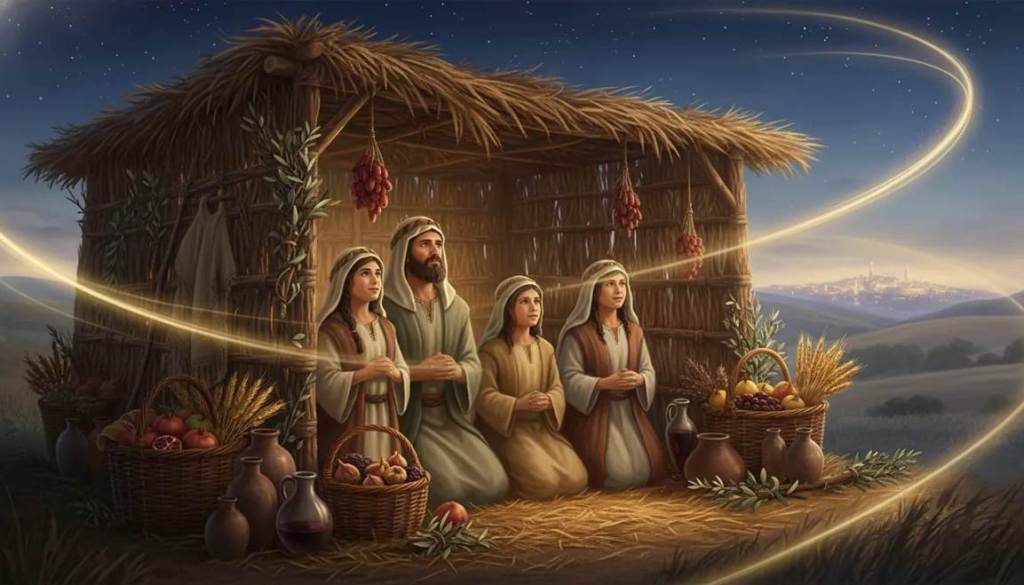
One of the more revealing modern complaints about worship is this one: “I just didn’t get anything out of it today.” That is a wonderfully efficient way of announcing that the whole thing has been misunderstood. You did not come to worship because you are the object of worship. God is.
And in the law of God, that point was built right into Israel’s calendar. When Israel came before the Lord at the appointed feasts, they did not stroll in empty-handed, hoping for a religious pick-me-up. They came bearing gifts, sacrifices, tithes, thanksgiving, praise, and remembrance. Worship was not a consumer event. It was covenant renewal before the living God.
That brings us to the Feast of Tabernacles in Deuteronomy 16, the third of Israel’s great annual feasts. Like Passover and the Feast of Weeks, this feast was not filler. God does not hand out meaningless appointments. Every one of these feasts taught Israel who He is, who they are, and what He had done for them. And every one of them pointed forward to Christ.
The Three Great Feasts and Why They Mattered
Israel’s three great pilgrimage feasts were:
- The Feast of Unleavened Bread / Passover
- The Feast of Weeks / Pentecost
- The Feast of Tabernacles
These feasts reminded Israel of at least three foundational truths:
- God is their Redeemer.
- God is their Provider.
- They are one people of God.
That last point matters. Once Israel entered the land and spread out by tribe and territory, the temptation was to become fragmented, provincial, and forgetful. God required them to gather so they would remember that they were still one covenant people under one covenant Lord.
And that same principle helps us now. The gathered worship of God’s people ought to remind us that we belong to Christ unconditionally. We are His people, and we are not free agents making up religion as we go.
How the Earlier Feasts Pointed to Christ
Before looking at Tabernacles, it helps to keep the pattern in view.
Passover
Passover pointed to Christ directly. As Paul says, Christ is our Passover. The lamb in Egypt was not the final reality. Christ is. His blood delivers from condemnation, death, and slavery to sin.
The week of unleavened bread that followed also carried meaning. Leaven often signifies sin in Scripture. So the feast pointed toward a life marked by sincerity and truth, not corruption and hypocrisy.
The Feast of Weeks
The Feast of Weeks, or Pentecost, came fifty days after Passover. In the old covenant, this pointed back to Sinai, when God gave His law and ratified His covenant with Israel.
Then came the new covenant fulfillment. Fifty days after Christ, our Passover, was sacrificed, the Spirit was poured out at Pentecost. But instead of writing the law on tablets of stone, God wrote His law on the hearts and minds of His people.
And this must be said plainly: the new covenant is not lawless. Christ does not merely save His people from the penalty of sin while leaving them comfortably under its tyranny. He breaks the power of sin. A gospel that says Jesus forgives but does not transform is too small, too weak, and not the biblical gospel at all.
The Feast of Tabernacles: Name, Timing, and Setting
The Feast of Tabernacles is also called the Feast of Booths or the Feast of Ingathering. The Hebrew term refers to temporary shelters made from branches, thickets, and leafy boughs. Think huts, booths, rough wilderness shelters.
That second name, Feast of Ingathering, tells you something immediately. This feast was tied to the agricultural year. It came at the close of the harvest season, after the produce of the land had been gathered in.
When It Was Celebrated
Deuteronomy 16 tells us it lasted seven days. Leviticus 23 and Numbers 29 supply the exact date: it began on the fifteenth day of the seventh month, around September or October on our calendar.
The seventh month in Israel was packed with significance:
- The first day was a holy convocation
- The tenth day was the Day of Atonement
- The fifteenth day began the Feast of Tabernacles
- The feast itself was bracketed by special Sabbath rests
In other words, this whole period was sacred time. And there is a fitting rhythm to it. First came atonement. Then came rejoicing. Five days after the high priest made atonement for the sins of the nation, the people gathered to celebrate mercy, provision, and the goodness of God.
That is not accidental. Forgiveness and joy belong together.
What the Feast Remembered in Israel’s History
Leviticus 23 gives the crucial explanation. Israel was to dwell in booths during this feast:
“That your generations may know that I made the children of Israel dwell in booths when I brought them out of the land of Egypt.”
This is important. The feast was not simply about remembering the forty years of wilderness wandering after Israel’s rebellion. It reached back earlier, to the period between the Exodus and Sinai. Before Kadesh-barnea. Before the nation’s great unbelief. Before the long judgment in the wilderness.
God is saying, in effect, “Remember what I did for you when I first brought you out.”
What Israel Saw While Dwelling in Booths
During that period, Israel had no permanent homes. They were exposed, vulnerable, and entirely dependent on God. And what did God do?
- He delivered them through the Red Sea
- He destroyed the Egyptian army
- He provided water in the wilderness
- He made bitter water sweet
- He brought water from the rock
- He gave manna from heaven
- He protected them from enemies like Amalek
That is what the feast was designed to keep before them. The booths were not quaint little props. They were a sermon made of branches.
God had taken them out of solid homes in Egypt, brought them through a dangerous wilderness, and kept them alive in flimsy shelters that offered no real security on their own. The point was not the sturdiness of the huts. The point was the faithfulness of God.
Why God Made Them Leave Their Houses and Sit in Booths Again
Once Israel entered Canaan, they would no longer be living in temporary shelters. They would have cities they did not build, wells they did not dig, vineyards and olive trees they did not plant. They would live in houses full of good things.
And that, precisely, was the danger.
Comfort has a way of erasing memory. Full bellies are often enemies of gratitude. Prosperity whispers the oldest lie in the book: “My power and the might of my hand got me this wealth.”
So God told them to leave those comfortable homes and go sit in booths for a week.
Why?
Because He wanted them to remember.
- Remember where you came from
- Remember who brought you here
- Remember who protected you
- Remember who fed you
- Remember who gave you everything you now enjoy
This is one reason fathers in Israel had such a central role in the feast. A child asks, “Why are we leaving our house to sleep in a hut?” And the father says, “Because our God brought us through the wilderness and kept us alive. Because these blessings did not come from us. Because we dare not forget Him.”
That is catechism by calendar.
The Feast as a Lesson in Trust
There was another element here too. Three times a year, Israelite males were required to appear before the Lord in the place He chose. That meant leaving farms, homes, fields, and borders behind.
Who would guard everything while they were gone?
God would.
That requirement itself was an act of faith. It declared that the true security of Israel was not locked gates, high walls, or sharpened steel. Their safety was the Lord.
If God is not your protector, your other precautions amount to little more than decorative anxiety. And if God is your protector, then even a booth of branches is safer than a fortress without Him.
The Agricultural Meaning of the Feast
The Feast of Tabernacles was also tied to the land itself. Deuteronomy 16 connects it to the end of the harvest, after the produce had been gathered from the threshing floor and winepress.
This was Israel’s great harvest festival, their annual ingathering. It was a season of thanksgiving for God’s provision through the ordinary means of rain, sun, soil, labor, and fruitfulness.
The End of the Harvest Year
By this point in the agricultural cycle, the major produce had come in:
- Olives harvested in September
- Figs brought in during August
- Grapes harvested in August and September
- Pomegranates gathered in September
This fits the language of Deuteronomy 8, where the promised land is described as a land of wheat, barley, vines, fig trees, pomegranates, olive oil, and honey.
So Tabernacles was thanksgiving, but not in the thin and sentimental sense. It was thanksgiving with memory. Thanksgiving with covenant obligations. Thanksgiving with sacrifices. Thanksgiving with shared joy.
It was a feast at the end of the year when the people could look at barns, presses, baskets, and storehouses and say, “The Lord has been good to us.”
This Was a Joyous Feast
If there is one note that rings through the Feast of Tabernacles, it is this: rejoice.
Deuteronomy says:
- You shall rejoice in your feast
- You shall surely rejoice
And that rejoicing was not private or stingy. It included:
- sons and daughters
- male and female servants
- Levites
- strangers
- the fatherless
- widows
In other words, the joy of God’s people was to overflow. Those who had been blessed were to make room at the table for those in need. The feast did not sanctify selfishness. It required generosity.
And there is something worth saying here plainly. A lot of people read the Old Testament as though it were all heaviness and gloom. But these feasts were not funeral dirges. They were celebrations. The people of God under the old covenant had reasons to rejoice, and Christians under the new covenant have even more.
The Ceremonies of the Feast
The Feast of Tabernacles had several ceremonial features.
1. A Special Sabbath at the Beginning and End
The first day was a holy convocation and a Sabbath rest. The eighth day also concluded with solemn assembly and rest. The feast was enclosed by worship and cessation from ordinary labor.
2. Dwelling in Booths
For seven days the Israelites were to live in booths made from branches and leafy boughs. This was the visible, tactile reminder of the wilderness and the Lord’s preserving care.
3. Sacrifices and Offerings
The people did not come empty-handed. This mattered then, and the principle still bites now.
Worship is not fundamentally about what you got. It is about what you bring before God. You come with thanksgiving, praise, repentance, faith, generosity, and adoration. God is the audience. You are not.
During the feast, Israel brought tithes, thank offerings, freewill offerings, and sacrifices. Numbers 29 details the additional offerings of the feast. Over the seven days, the priesthood offered:
- 70 bulls
- 14 rams
- 98 lambs
- 7 goats
There was a descending number of bulls each day, from thirteen on the first day down to seven by the seventh day. Then came the solemn assembly on the eighth day.
This was not casual worship. It was costly, communal, joyful, and serious.
Important Moments in Israel’s History Connected to Tabernacles
The Feast of Tabernacles continues to show up at pivotal moments in the Old Testament.
- Every seven years, during the year of release, the law was to be read publicly at the feast.
- Solomon’s temple was dedicated at this time.
- After the exile, the returned Jews rebuilt the altar and resumed sacrifice in connection with the feast.
- In Nehemiah’s day, the feast was kept with exceptional zeal and rejoicing.
- In Zechariah 14, the nations are pictured as coming up to keep the Feast of Tabernacles in the latter-day triumph of God’s kingdom.
That last point is especially important. Tabernacles became a prophetic image of the universal reign of the Messiah and the worship of God among the nations.
How the Feast of Tabernacles Is Fulfilled in Christ
The New Testament tells us that the feasts were shadows, and that the substance belongs to Christ. A shadow is real enough as an outline, but it is not the thing itself. Christ is the reality casting the shadow.
So how does Tabernacles point to Him?
Jesus and Living Water in John 7
John 7 takes place during the Feast of Tabernacles. On the last and greatest day of the feast, Jesus stood and cried out:
If anyone thirsts, let him come to Me and drink.
That was no throwaway line. During the feast, water symbolism was tied to God’s wilderness provision. Israel remembered the water from the rock. And in the middle of that setting, Jesus says, in effect, “That water pointed to Me.”
He is the true source of living water. He is not merely another teacher in attendance at the feast. He is the fulfillment of the feast.
And the promise is not only that believers receive this living water, but that it overflows. Out of the believer’s heart flow rivers of living water. Which means Christians are not to be stoppered bottles. The gospel is meant to pour forth.
Jesus and the Bread From Heaven
This same line of fulfillment runs alongside John 6, where Jesus identifies Himself as the bread of life. God fed Israel in the wilderness with manna. Christ says that provision was also about Him.
Water from the rock. Bread from heaven. All of it was pointing forward.
Jesus Tabernacled Among Us
John 1 says, “The Word became flesh and dwelt among us.” The language there is rich. The sense is that He tabernacled among us.
Just as God dwelt with Israel in the tabernacle in the wilderness, so now in the incarnation God has come near in Christ. Jesus took on flesh and lived among His people. The God of heaven stooped down and pitched His tent with us.
Tabernacles pointed there too.
The Feast of Tabernacles and the Final Harvest
But there is still more. The Feast of Tabernacles does not only point backward to wilderness provision or upward to incarnation. It points forward to the completion of Christ’s kingdom.
This is where the harvest imagery becomes glorious.
The Pattern of the Feasts and Redemptive History
There is a sequence to the feasts:
- Passover points to Christ’s sacrificial death and resurrection as firstfruits
- Pentecost points to the gift of the Spirit and the ingathering of souls
- Tabernacles points to the final harvest at the end of history
Paul’s teaching in 1 Corinthians 15 fits this beautifully. Christ is the firstfruits of those who sleep. Then comes the harvest. Then comes the end, when He has put all enemies under His feet. The last enemy to be destroyed is death.
That is Tabernacles language. Final ingathering. Final joy. Final victory.
Zechariah 14 ties the triumph of God’s kingdom to this feast as well. The nations come to worship the King and keep the Feast of Tabernacles. Whatever one’s millennial timetable may be, the point is unmistakable: this feast becomes a sign of Christ’s worldwide reign and the submission of the nations to Him.
Revelation and the Ultimate Tabernacle
The final horizon of this feast appears in Revelation 21:
Behold, the tabernacle of God is with men, and He will dwell with them.
There it is. The great end. New heavens and new earth. God dwelling with His people. No more tears. No more pain. No more death. No more sorrow.
This is the true and everlasting Feast of Tabernacles.
Right now, we live in temporary tabernacles. Our bodies are still subject to weakness, pain, decay, and death. The inner man has been renewed in Christ, but the body has not yet been fully redeemed. We still groan. We still fight sin. We still bury our dead. We still walk through the wilderness.
But not forever.
There is a final ingathering coming. There is a resurrection coming. There is a day when the temporary booth gives way to the glorified habitation of the sons of God.
How Christians Keep the Feast of Tabernacles Now
No, Christians are not commanded to rebuild the Mosaic feast calendar. Christ is the fulfillment. But the meaning of Tabernacles still belongs to us, and we keep it in the way fulfillment always works. We keep it by living in the reality to which it pointed.
That means at least three things.
1. Remember God’s Provision
We are every bit as dependent on God as Israel was. We may be more insulated from the farming process, but we are no less needy. Every meal is mercy. Every glass of water is kindness. Every protection from danger is providence.
Teach that to your children. Say it out loud. Do not let blessings pass by unnamed.
2. Live as Pilgrims in Temporary Tents
This world is not your final home. Your body in its present condition is not your final condition. Christians should neither idolize comfort nor despair in suffering. We dwell in temporary tabernacles now, but we await the permanent one.
3. Labor for the Final Harvest
If Tabernacles points to the final ingathering, then the church must care about the harvest now. Christ is gathering a people from every tribe and tongue and nation. The nations belong to Him. And the ordinary means He uses is the proclamation of His Word.
Faith comes by hearing, not by “good vibes.” A decent life adorns the gospel, but it is not the gospel. The living water must flow from the mouths of God’s people. Silent Christianity is a contradiction with polished manners.
The Lord of the harvest desires the nations. His people should too.
A Final Word on Worship, Joy, and the World to Come
The Feast of Tabernacles was a feast of joy. It looked back on God’s saving acts, celebrated His present provision, and anticipated His future triumph.
That is why joyless worship is such a strange thing. If you resent worship now, you will not enjoy eternity very much, because the age to come is not less full of God. It is more. Heaven and the new earth are not places where Christ is politely acknowledged and then everyone hurries off to more important business. They are places where righteousness dwells, where God is with His people, and where redeemed humanity rejoices before Him forever.
So remember the feast.
Remember the wilderness.
Remember the water from the rock and the bread from heaven.
Remember the God who protects His people even when they dwell in booths.
Remember the Christ who stood in the middle of Tabernacles and declared Himself to be the living water.
And remember that history is headed somewhere. There is a final harvest coming, and the King will have it.
When that day arrives, the people of God will not come empty-handed. They will come with joy.
For full sermon: YouTube – https://youtu.be/X57SJ-_y-8E
For full Sermon: Sermon Audio – DEUT062 – The Feast of Tabernacles | SA Dashboard
 Grace Reformed Baptist Church