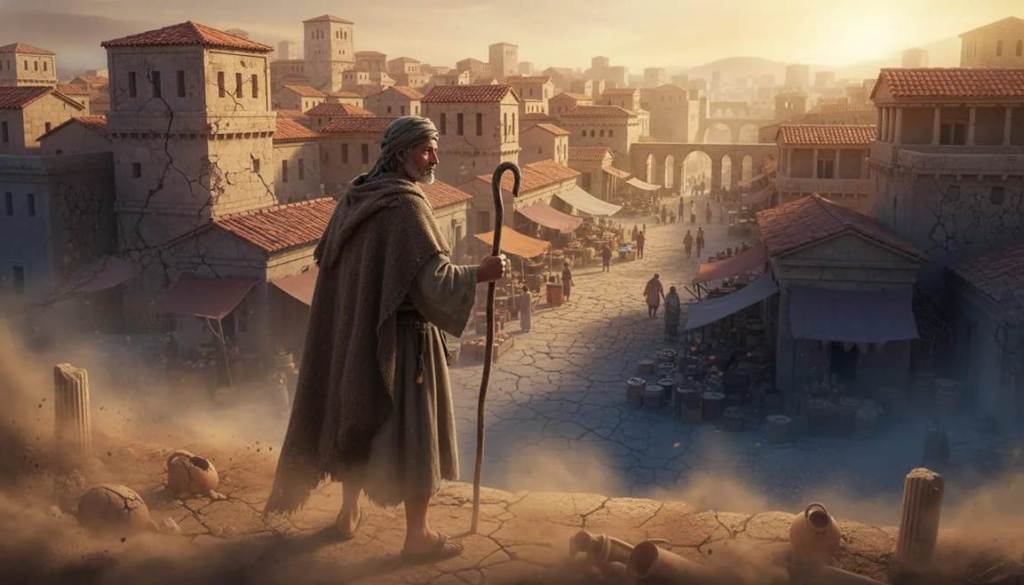
There are moments in Scripture when a man from nowhere walks into the center of power and says the one thing nobody wants said out loud. Amos is one of those moments.
A shepherd from Tekoa, dusty and ordinary, walked into the richest city in Israel during its most prosperous years and announced that the whole thing was already coming apart. The borders were expanding, trade was flowing, worship services were full. The wealthy were decorating second homes. The national mood was confidence, and Amos came to say that confidence was built on rot.
That is why the book of Amos still lands like a hammer. It is not merely an ancient prophecy for a vanished kingdom. It is one of the Bible’s sharpest exposures of what happens when a people confuse prosperity with divine approval. Amos insists on a truth that every age resists:
Prosperity without justice is not blessing. It is a countdown.
Who Amos Was, and Why His Background Matters
Amos was not a professional prophet. He tells us so himself in Amos 7:14. He was “no prophet, nor a prophet’s son,” but a herdsman and a dresser of sycamore figs.
That detail matters.
He did not come out of a prophetic guild. He did not have institutional credentials. He was not a polished religious insider who had learned how to speak safely. He came from Tekoa, a small town about ten miles south of Jerusalem, perched out near the wilderness. This was rugged country, not the sort of place that usually produces national voices.
His work was humble. He tended sheep. He cared for sycamore fig trees, a crop associated with the poor, not the elite. And even his name seems fitted to his calling. Amos is tied to a Hebrew root meaning to carry a load or bear a burden. He was, in a very real sense, a burden-bearer. He carried a message no one wanted and could not put down.
That pattern is not unusual in Scripture. God often chooses the man at the edge of the map rather than the man in the center of the system. Moses was a shepherd in exile. David was the forgotten brother in the field. Gideon was hiding. Amos was tending figs and flocks. The Lord has never been overly impressed with credentials. The scriptural principle – God gives grace to the humble, but resist the proud.
The World Amos Walked Into
Amos prophesied during the reigns of Uzziah in Judah and Jeroboam II in Israel. Jeroboam II ruled the northern kingdom during one of the most successful periods it ever enjoyed, roughly 786 to 746 BC. By outward measures, everything looked excellent.
- The army was strong.
- The borders had expanded.
- Trade was flourishing.
- Luxury was increasing.
- Religious life was active.
Archaeology has turned up carved ivory fragments in Samaria, the capital, confirming the sort of luxury Amos describes when he speaks of beds of ivory and extravagant living. In other words, the prophet was not exaggerating. He was looking at a genuinely affluent society.
And yet he says that this prosperity was not proof of health. It was camouflage.
Amos lived alongside other great prophets. Hosea was speaking to the northern kingdom at about the same time, though with a different accent. Hosea emphasizes God’s wounded love. Amos drives his fist into the question of justice. Isaiah would begin not long after in Judah. Jonah had already prophesied earlier in Jeroboam’s reign. Amos was part of a prophetic generation, but his message is among the most direct in all the Old Testament.
Two Years Before the Earthquake
The book opens with a striking historical marker. Amos says his ministry took place “two years before the earthquake.” That was not a poetic flourish.
Excavations at sites such as Hazor, Lachish, and Gezer have uncovered evidence of a major seismic event around 750 BC. It appears to have been severe enough to damage structures across the region. The event was remembered for generations.
So the setting is almost eerie. Before the ground physically shook, Amos was already declaring that the moral ground under Israel was unstable. The earthquake would become a fitting sign of what he had been saying all along. A society can look solid right up until it starts to crack.
The Shape of the Book of Amos
The book is only nine chapters long, but it moves with remarkable force. It helps to see its basic structure before working through the details.
1. Chapters 1 and 2: Oracles Against the Nations
Amos begins by pronouncing judgment on Israel’s neighbors: Damascus, Gaza, Tyre, Edom, Ammon, and Moab. Then he turns to Judah. And finally, when the audience is likely nodding along in satisfaction, he turns the blade on Israel itself.
2. Chapters 3 through 6: Sermons of Indictment
These chapters are the heart of the book’s accusation. Amos exposes luxury without compassion, commerce without honesty, and worship without obedience.
3. Chapters 7 through 9: Visions of Judgment and a Final Hope
The closing section contains five visions, a confrontation with Amaziah the priest at Bethel, and then, suddenly and gloriously, a promise of restoration.
Amos knows how to preach. He begins with the sins of others, draws his audience in, and then lets them discover that they are the ones standing on trial.
When God Hates Worship
One of the most unsettling things in the book of Amos is that Israel was not suffering from a lack of religion. Quite the opposite. Bethel, one of the royal sanctuaries in the northern kingdom, was bustling. There were priests, sacrifices, songs, feast days, offerings, and liturgical noise in abundance.
And God says he hates it.
“I hate, I despise your feast days… Though you offer Me burnt offerings and your grain offerings, I will not accept them… Take away from Me the noise of your songs.”Amos 5
That ought to stop a reader cold. The Lord is rejecting worship he himself had once commanded. Why? Because the outward form remained while the moral substance had been gutted.
The answer comes in Amos 5:24, one of the most famous lines in the prophets:
“But let justice roll down like waters, and righteousness like a mighty stream.”
This is not a sentimental slogan. It is a rebuke.
What “Justice” and “Righteousness” Mean in Amos
The two Hebrew words in Amos 5:24 are worth slowing down for.
Mishpat
Mishpat means justice in the sense of fair judgment. It is a legal word. It has to do with giving people their due, protecting the vulnerable, deciding cases rightly, and making sure the weak are not devoured by the strong. This is the kind of justice administered at the city gate, where public disputes were heard.
Tsedaqah
Tsedaqah, often rendered righteousness, refers to right relationships and upright dealing in community. It is not merely private piety. It includes ethical integrity in how one treats others.
The two belong together. Mishpat is the just action. Tsedaqah is the righteous character that produces it.
And Amos says these things should roll down like waters. Not like a seasonal trickle. Not like a wadi that fills during the rains and dries to dust by midsummer. He wants a permanent river, something steady, forceful, life-giving, and impossible to ignore.
Israel had plenty of religious activity, but the riverbed of justice was dry.
The Specific Sins Amos Saw
Amos is not content with generalities. He names the disease in specific forms, and the precision of it is part of what gives the book its bite.
The “Cows of Bashan”
In Amos 4, he addresses the wealthy women of Samaria as the “cows of Bashan.” Bashan was known for fattened cattle because it was fertile and well-watered. The insult is deliberate and severe.
But the point is not simply that they are wealthy. The point is that their comfort is being financed by oppression.
“Hear this word, you cows of Bashan… who oppress the poor, who crush the needy, who say to your husbands, ‘Bring wine, let us drink!’”
Amos is not condemning abundance as such. He is condemning abundance built on exploitation.
Beds of Ivory and Numb Hearts
In Amos 6, the prophet turns to the men of the elite class. They recline on beds of ivory, stretch out on couches, feast on choice meat, improvise songs, drink wine by the bowl, and anoint themselves with the finest oils.
Again, the deepest problem is not the luxury in isolation. It is the deadness that comes with it.
“But are not grieved for the affliction of Joseph.”
There it is. The nation is breaking and they feel nothing. The suffering of others does not reach them. Prosperity has become anesthesia.
And the archaeological evidence from Samaria fits the description. The ivory was real. So was the numbness.
Cheating in the Marketplace
Amos 8 takes the indictment into the economy itself. The merchants are impatient for religious holidays to end so they can get back to business, which in this case means back to fraud.
They ask, in effect, when the new moon and Sabbath will be over so they can sell grain again. Then they manipulate the ephah and the shekel, shrinking the amount sold and increasing the cost paid. They falsify scales and mix in the bad wheat with the good.
The result is brutal. The poor, already cornered, are reduced to debt slavery for the price of a pair of sandals.
This is one of the most important things Amos reveals. The people he rebukes are not irreligious pagans who have abandoned worship. They are religious people who maintain the rituals while gutting the ethics. They keep the feast days and cheat their neighbors. They sing songs at the sanctuary and tamper with the scales in the market.
And God notices both ends of that arrangement.
The Five Visions of Amos and the Limits of Patience
The second half of Amos contains five visions, and together they show something crucial about divine judgment. God does not move toward judgment hastily. He warns, delays, and relents. But patience is not indifference, and mercy abused does not remain available forever.
First Vision: The Locusts
Amos sees a swarm of locusts forming just as the late crop is coming up. In an agricultural society, this would mean devastation and famine. Amos cries out, asking God to forgive, because Jacob is small and cannot stand.
And the Lord relents.
Second Vision: The Fire
Then Amos sees a consuming fire, a drought so intense it dries up even the deep waters and threatens to devour the land. Again Amos intercedes. Again the Lord relents.
This is one of the striking truths in Amos. The prophet is not merely an announcer of doom. He is also an intercessor. And God is not eager to destroy. He holds back judgment when appealed to. The same divine character seen in Abraham’s pleading over Sodom is at work here as well.
Third Vision: The Plumb Line
Then comes the turning point.
God shows Amos a plumb line. A plumb line is a builder’s tool, a string with a weight at the end used to determine whether a wall is straight. Gravity does not lie. If the wall leans, the plumb line exposes it.
“Behold, I am setting a plumb line in the midst of My people Israel; I will not pass by them anymore.”
This time Amos does not intercede.
That silence matters. The issue is not that God has suddenly become capricious. The issue is that Israel has reached the point where the structure must be measured. A wall cannot be repaired with cosmetics if it is fundamentally unsound. It must be torn down and rebuilt.
Amos 4 prepares us for this with a chilling refrain. God lists famine, drought, crop failure, plague, military loss, and upheaval, and after each one comes the same verdict: “Yet you have not returned to Me.” The warnings had been many. The refusal had been persistent.
Fourth Vision: The Basket of Summer Fruit
In chapter 8, Amos sees a basket of ripe summer fruit. In Hebrew there is a wordplay. The word for summer fruit sounds like the word for end. The fruit is ripe, and so is the nation. It cannot be kept much longer. It is at the edge of spoilage.
The image is simple and devastating. Israel is not merely sinful. Israel is overripe.
Fifth Vision: The Struck Sanctuary
In chapter 9, the Lord is seen beside the altar at Bethel, announcing judgment on the sanctuary itself. The place Israel trusted as spiritual insurance would become the place where judgment fell.
That is a severe warning for every age. A religious institution can become so compromised that the very thing people trust in becomes part of their downfall.
The Showdown with Amaziah at Bethel
Right in the middle of these visions comes a personal confrontation. Amaziah, the priest of Bethel, sends word to King Jeroboam II accusing Amos of conspiracy. Then he tells Amos to go back to Judah and earn his bread there. In effect, he says: take your prophecies somewhere else.
And then Amaziah lets the whole game slip.
“For it is the king’s sanctuary, and it is the royal residence.”
There it is in plain sight. Bethel is functioning as an arm of the state. The sanctuary exists to serve the throne. Religion has been harnessed to political power, and Amos is dangerous because he will not play along.
Amos answers with one of the great statements of prophetic calling:
“I was no prophet, nor a prophet’s son… but I was a herdsman and a dresser of sycamore figs. Then the Lord took me as I followed the flock, and the Lord said to me, ‘Go, prophesy to My people Israel.’”
That is about as clean as it gets. Amos did not choose a career in prophecy. He was seized by a call. He had no résumé that Bethel would respect. He had a commission, and that was enough.
This is deeply encouraging for ordinary people. The Lord does not require institutional approval before he can use a man. If anything, he often sends men precisely because they are outside the approved channels.
Is There Any Hope in Amos?
Yes, and it comes so suddenly at the end that a careless reader can miss it.
After all the judgments, all the warnings, all the visions, Amos closes with five verses of restoration. They are not sentimental. They are seismic.
“On that day I will raise up the tabernacle of David, which has fallen down, and repair its damages; I will raise up its ruins, and rebuild it as in the days of old.”
The phrase “tabernacle of David” can also be rendered the booth or shelter of David. The picture is of the fallen Davidic house being raised again. But the promise does not stop with Israel’s internal repair. It widens to include the nations.
The Gentiles, those outside Israel by birth, are brought into view.
That is not a minor footnote. It is a doorway into the New Testament.
Amos and Acts 15: The Rebuilt Tabernacle of David
In Acts 15, the early church gathers in Jerusalem to settle a crucial question: do Gentile believers have to become Jews in order to belong to the Messiah?
James stands up and quotes this closing passage from Amos. He interprets the influx of Gentiles into the church as the fulfillment of Amos’s restoration promise. The fallen tent of David is being rebuilt, and as it is rebuilt, the nations are coming in.
That means the end of Amos is not just a vague promise that things will somehow improve. It is a messianic horizon. The prophet who warned of collapse also foresaw the restoration that would come through the house of David, fulfilled in Jesus Christ and extended to all peoples.
The shepherd from Tekoa saw beyond the ruins.
How Amos Points to Jesus
By the time the Bible reaches its culmination, it becomes clear that the plumb line God holds up to his people is his own character. He is just, faithful, merciful, unwavering in his concern for the poor and oppressed, and intolerant of worship divorced from obedience.
That character entered history in Jesus.
Jesus stands in the line of Amos in more ways than one.
- He confronted a temple system corrupted by commerce.
- He reserved some of his sharpest rebukes for religious professionals who maintained appearances while missing the point.
- He spoke of judgment in terms that echo the prophets.
- He defined genuine obedience in profoundly practical terms.
In Matthew 25, when Jesus speaks of the final judgment, he does not evaluate people by liturgical enthusiasm alone. He speaks of feeding the hungry, clothing the naked, welcoming the stranger, visiting the prisoner. That is not alien to Amos. That is Amos brought into full daylight.
Mishpat. Tsedaqah. Justice and righteousness made concrete.
And then Jesus goes farther than Amos ever could. Amos carried a burden in the form of a word. Jesus carried the burden of sin itself. The prophet’s very name suggests burden-bearing, and the gospel reveals the true burden-bearer. The line from Amos to Christ is not forced. It is organic. Prophecy leads to person. The plumb line leads to the cross.
What Amos Means Right Now
Amos is not difficult to apply. Painful, yes. Difficult, no.
His central question is plain enough: Is worship connected to life?
Not to ideals. Not to slogans. To life.
Amos does not call for less worship. He calls for integrated worship. He wants the songs to spill into the marketplace, the courtroom, the home, the contracts, the payroll, the treatment of the poor, and the conduct of those who hold power.
That means the book presses on the ordinary week, not just the sacred hour.
Questions Amos Forces Us to Ask
- Where did my attention go this week?
- Who did I make time for?
- When I saw someone struggling, did I turn toward them or away?
- When I had a chance to speak for someone with no voice in the room, did I?
- What do my financial choices reward?
- Have I built comforts that make me less grieved by the affliction of others?
Amos is not asking for theatrical displays of moral intensity. He is asking for the river to begin flowing. Even a small current can carve a channel over time. A heart, a family, a church, a community that begins to practice mishpat and tsedaqah will not remain the same.
A Word for the Ordinary and Overlooked
There is another comfort in this book, and it is one that should not be missed.
If you feel ordinary, unseen, uncredentialed, and outside the rooms where important things are decided, Amos ought to hearten you. God has a history of calling people from the edges. From Tekoa. From sycamore groves. From flocks. From places that nobody in the capital is paying attention to.
If you cannot shake the sense that something is crooked, something false, something whitewashed and leaning, do not dismiss that burden too quickly. It may be more than temperament. It may be vocation.
Amos was not supposed to be famous. He simply saw what was happening and said it aloud. Nearly three thousand years later, his words still make the blood run cold and the conscience wake up.
The End of the Story: Ruins Raised, River Flowing
The book of Amos ends where all faithful prophecy ends: not in sentimentality, but in hope grounded in God’s action.
The fallen tabernacle of David will be rebuilt. The ruins will be raised. The nations will be gathered under a name they did not inherit by birth but receive by grace.
That promise begins to flower in the resurrection of Jesus. It continues wherever justice starts flowing again in human communities. And it reaches forward to the final picture Scripture gives, where God dwells with his people, wipes away tears, and a river of life runs clear through the city.
Amos saw the dry riverbed and cried out against it. The Bible ends with the river running full.
That is where the story was headed all along.
 Grace Reformed Baptist Church