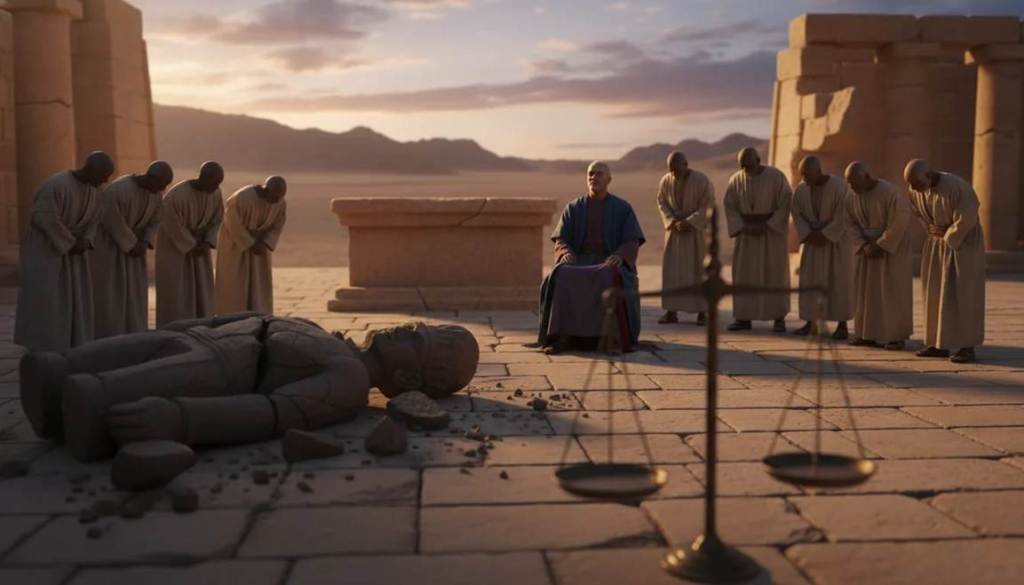
Deuteronomy 16:21 to 17:7 is one of the more difficult passages in the Old Testament. It brings together several weighty themes at once: true worship, covenant faithfulness, idolatry, and judicial procedure in capital cases.
If you have ever wondered what this passage means, why idolatry is treated so seriously, or what principles it teaches about justice, this guide will help you work through it clearly and carefully.
The core message is simple: God takes His worship seriously, and He requires truth and justice when serious accusations are made.
What does Deuteronomy 16:21 to 17:7 say?
This passage contains two closely connected parts.
- Deuteronomy 16:21 to 17:1 warns Israel not to corrupt the worship of God.
- Deuteronomy 17:2 to 17:7 explains how Israel’s judges were to handle a capital case involving apostasy and idolatry.
Together, these verses show that false worship was not a minor issue in Israel. It was treated as a covenant-breaking offense with serious consequences.
Why this passage matters
Many people read this text and focus only on the severity of the penalty. That reaction is understandable. But if you stop there, you miss the larger point.
This passage is not only about punishment. It is also about:
- The exclusivity of covenant loyalty to God
- The danger of mixing false worship with true worship
- The need for careful investigation before judgment
- The public responsibility of leaders to uphold justice
In other words, this is both a passage about worship and a passage about justice.
What is apostasy in Deuteronomy 17?
In this context, apostasy means turning away from the God of the covenant to serve and worship other gods.
This is more than general unbelief. The passage speaks about someone within Israel, someone who belongs to the covenant community, who then rejects that allegiance and gives worship elsewhere.
That distinction matters. The concern here is not simply that pagan nations worshiped false gods. The issue is that a member of the covenant people would abandon the God to whom they were bound.
That is why the act is treated as a form of treason against the covenant.
What is idolatry in this passage?
Idolatry in Deuteronomy 17 includes serving and worshiping false gods, including created things such as the sun, moon, or host of heaven.
The basic idea is clear: worship is owed to God alone. When a person gives that devotion to anything else, whether a carved symbol, a heavenly body, or another deity, that person violates the first commandment.
The passage treats this as a direct rebellion against God, not merely a private spiritual preference.
Why are the warnings about worship placed before the legal case?
Before the passage describes the prosecution of apostasy, it warns Israel not to:
- Plant a tree or wooden cult object near the altar
- Set up a sacred pillar
- Offer blemished sacrifices
These warnings are important because they show how spiritual decline often begins.
It usually does not begin with open, full-scale apostasy. It begins with corruption in worship.
Two patterns appear here:
1. Mixing false religion with the worship of God
This is often called syncretism. It means blending elements of pagan worship into the worship God has appointed.
The prohibited tree and pillar were not neutral decorations. They were associated with pagan religious practice. Bringing them near the altar meant importing foreign worship into the worship of the Lord.
2. Careless worship driven by self-interest
Offering a blemished animal showed disregard for God. It revealed a heart that wanted to keep the best for itself while giving God what was defective.
That kind of worship is not reverent. It is careless and self-serving.
Taken together, these warnings teach a practical lesson: false worship often begins with compromise before it becomes open rebellion.
Why was idolatry treated as such a serious crime in Israel?
To modern readers, the severity of the law can seem shocking. But the logic of the text is covenantal.
Israel was not just another nation. It was a people specially bound to God by covenant. That covenant required exclusive loyalty. So when an Israelite turned to other gods, it was not simply a bad choice. It was a direct violation of that covenant relationship.
A helpful way to understand the gravity is this: if covenant involves pledged faithfulness, then abandoning God for idols is spiritual unfaithfulness at the highest level.
The passage also assumes that idolatry is not a harmless private act. It has a spreading effect. Left unchecked, it can corrupt the community and bring judgment on the nation.
Who was this law for?
This law applied to members of Israel’s covenant community. The text specifically refers to someone found “among” the people and “within” the gates of Israel.
That means the law is addressing those under Israel’s covenant order and judicial jurisdiction.
This point matters because it helps avoid a common misunderstanding. The passage is not describing a general policy for all nations toward all people everywhere. It is describing how covenant-breaking idolatry was to be handled within Israel.
What judicial process does Deuteronomy 17 require?
One of the most important features of this passage is that it does not permit rash judgment.
Even in a capital case, the text requires a careful process.
Step 1: A credible report must be brought forward
The case begins when wrongdoing is reported. The accusation cannot simply remain vague rumor floating around the community. It must be brought to the proper authorities.
Step 2: The matter must be investigated diligently
The judges were not allowed to act on hearsay alone. They had to inquire carefully.
This means the accusation had to be tested. Facts had to be established. The charge had to be examined rather than assumed.
Step 3: The case had to be proven true and certain
The text requires more than suspicion. The offense had to be shown to be true and established.
That principle is foundational to biblical justice. A serious penalty demands serious proof.
Step 4: There must be two or three witnesses
No person could be put to death on the testimony of one witness alone.
This rule guards against false accusation, personal vendetta, and hasty condemnation. It sets a high standard of evidence in capital cases.
Step 5: Judgment is carried out publicly
The convicted person was brought to the gates, the public place of judgment. The sentence was not hidden in secrecy.
Public justice underscored the seriousness of the offense and the communal nature of covenant life in Israel.
Step 6: The witnesses were first in the execution
This detail is striking. The witnesses had to begin the execution themselves before the rest of the people joined in.
Why does that matter? Because it placed a solemn burden on the accusers. Anyone bringing such a charge had to stand behind it fully. This discouraged casual or malicious testimony.
What principles of justice does this text teach?
Even if you are studying this passage mainly for its theological meaning, the legal principles are impossible to miss.
Here are the major ones:
- Justice requires evidence, not rumor
- Serious accusations require careful investigation
- Capital cases require multiple witnesses
- Judgment must be based on established truth
- Public accountability matters
- Accusers must bear responsibility for their testimony
These are not minor details. They show that biblical justice is neither reckless nor arbitrary.
Common misunderstanding: this passage is only about punishment
That is one of the biggest mistakes people make when reading Deuteronomy 17.
Yes, the penalty is severe. But the passage is also deeply concerned with procedure.
It does not authorize mob action. It does not allow secret accusation. It does not permit execution on a single unverified claim.
Instead, it insists on due process, adequate testimony, and established truth.
So if you read only the penalty and ignore the process, you miss half the passage.
What does this teach about worship?
The passage teaches that worship is not a casual matter. God is not indifferent about how He is approached.
At minimum, Deuteronomy 16:21 to 17:1 makes these points:
- God’s worship must not be mixed with pagan practices
- God must not be offered defective or careless worship
- Exclusive devotion to God is part of covenant faithfulness
This means worship is not merely about sincerity. It is also about fidelity. A person can be deeply sincere and still worship wrongly.
What does this passage mean for Christians today?
This is where many readers have practical questions.
The passage is rooted in Israel’s covenant life and civil order. That means it should not be flattened into a simplistic one-to-one rule without careful thought. At the same time, it still teaches enduring truths.
Several principles remain highly relevant.
1. God still takes worship seriously
The importance of pure worship does not disappear. The warning against bringing false elements into the worship of God still deserves attention.
2. Apostasy is never a light matter
Turning away from God after professing allegiance to Him is spiritually serious. It should not be treated with indifference.
3. Covenant faithfulness matters
Promises made to God are not trivial. This passage reminds readers that covenant commitments are weighty and should not be handled casually.
4. Justice still requires due process
The judicial principles here remain instructive. Public accountability, multiple witnesses, diligent inquiry, and careful proof are not outdated values.
Does this passage support mob justice or impulsive punishment?
No.
If anything, the text pushes in the opposite direction. It slows judgment down. It requires investigation. It demands multiple witnesses. It puts responsibility on accusers. It makes the process public rather than secret.
That is very different from mob action, emotional reaction, or punishment based on untested allegations.
Why mention both men and women?
The passage explicitly says a man or woman may commit this offense and face the same consequence.
That detail shows that covenant obligations applied to both. The standard was not different based on gender. The law treated idolatry as a matter of personal responsibility before God.
How can this passage be applied practically?
Even where the ancient civil penalties are not directly carried over, the passage still gives a practical framework for thinking about worship, accountability, and justice.
For personal worship
- Ask whether your approach to God is shaped by Scripture or by convenience.
- Consider whether you are tempted to offer God leftovers rather than your best attention and devotion.
- Examine whether worldly influences have begun to shape what you think worship should be.
For church life
- Take spiritual drift seriously rather than dismissing it as unimportant.
- Care about those who begin turning away from God.
- Handle serious accusations carefully, truthfully, and openly.
For thinking about justice
- Do not equate accusation with guilt.
- Insist on evidence before judgment.
- Recognize that public authority must be accountable to standards of righteousness and justice.
A simple framework for reading difficult Old Testament laws
If you struggle with passages like this, this framework can help:
- Identify the original setting. Here, the setting is covenant Israel under God’s law.
- Ask what sin is being condemned. Here, it is covenant-breaking idolatry and corrupted worship.
- Notice the judicial safeguards. This passage includes investigation, witnesses, and public accountability.
- Look for enduring principles. God’s holiness, the seriousness of worship, and the need for just process remain important.
- Avoid shortcuts. Do not dismiss the text as cruel without examining its logic, and do not apply it carelessly without respecting its covenant context.
Pitfalls to avoid when studying Deuteronomy 16:21 to 17:7
- Ignoring the context of covenant Israel
- Reading the penalty without reading the procedure
- Treating worship as spiritually unimportant
- Assuming false worship begins only when apostasy becomes obvious
- Confusing accusation with proof
Frequently asked questions
What is the main point of Deuteronomy 17:2 to 7?
The main point is that covenant-breaking idolatry was a grave offense in Israel and had to be handled through careful, public, evidence-based judicial process.
Why does Deuteronomy mention the sun, moon, and stars?
Because idolatry often involved worshiping created things rather than the Creator. The passage explicitly rejects that practice.
What does “two or three witnesses” mean?
It means a person could not be convicted in a capital case on the unsupported accusation of a single witness. Multiple witnesses were required to establish the matter.
What is the connection between Deuteronomy 16:21 and 17:7?
The first section warns against corrupting worship. The second shows the legal consequences when covenant members fully turn to false worship. Together they trace a movement from worship corruption to open apostasy.
Is this passage mainly about government or religion?
It is about both. It deals with worship, covenant loyalty, and the role of judges in prosecuting a capital offense within Israel.
Key takeaway
Deuteronomy 16:21 to 17:7 teaches two truths that belong together.
First, God demands exclusive and pure worship. He does not accept the blending of false religion with true devotion, and He does not treat covenant unfaithfulness lightly.
Second, justice must be careful and truthful. Even in the most serious cases, guilt had to be established through diligent inquiry and multiple witnesses.
That combination is what makes the passage so important. It is a warning against both spiritual compromise and judicial recklessness.
For full sermon: https://youtu.be/-bDIfbRQzxI

