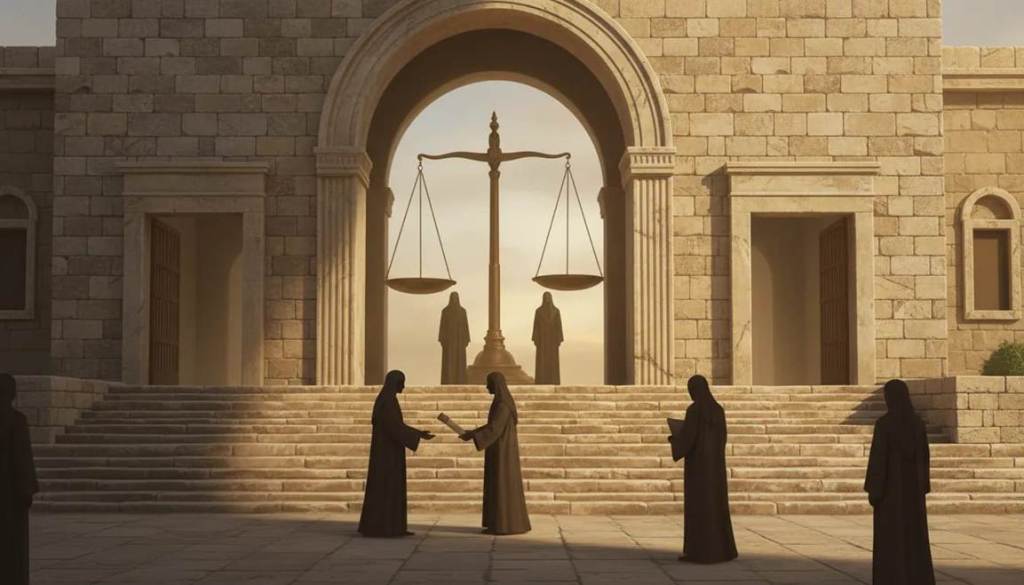
If you want to understand the Bible’s vision for a just legal system, Deuteronomy 17:8-13 is one of the key passages. It addresses a basic problem that every society faces. What should happen when a local judge encounters a case too difficult to decide?
The answer given in Deuteronomy is not chaos, not delay without end, and not arbitrary power. It is ordered judgment. Local judges handle ordinary matters. Hard cases go up to a central court. And once a lawful judgment is given, it must be obeyed.
That is the heart of the passage.
And it matters for more than ancient Israel. This text gives a framework for thinking about justice, courts, lawful authority, and the limits of human judgment. It also helps explain how biblical law expected legal systems to work when facts were disputed, penalties were unclear, or judges themselves were divided.
What Deuteronomy 17 says about difficult legal cases
Deuteronomy 17:8-13 deals with cases that are “too hard” for local judges. The setting assumes that Israel already has judges in its towns. Those judges are expected to render just decisions. But sometimes a case would arise that was unusually complex.
The text names several kinds of disputes, including matters involving:
- Bloodshed, such as determining guilt in a homicide case
- Property disputes, where liability or restitution may be unclear
- Bodily injury, where the proper judgment or penalty must be determined
- Controversies in the gates, which can include disputes so difficult that local judges cannot reach agreement
When that happened, the case was not to be ignored. Justice was still required. The matter was to be taken to the place God chose, where priests, Levites, and the presiding judge would issue a sentence of judgment.
Why this passage matters
This is not a minor administrative detail. It shows that biblical law assumes all of the following:
- Justice must be pursued even in hard cases
- Local judges have real authority
- Some cases require a higher court
- Judges must apply God’s law, not invent their own standards
- A legal system collapses if final judgments can simply be ignored
In other words, Deuteronomy 17 is not only about having courts. It is about having an orderly hierarchy of judgment under God’s law.
The judicial problem: when local judges cannot decide
The passage begins with an “if.” That is important. This is case law. It describes what to do if a certain kind of legal problem arises.
The issue is not that God’s law is defective. The issue is that human judges are finite. A law may be clear in principle while still requiring wisdom in application.
That distinction matters.
A judge may know the law against murder, theft, or injury and still need help sorting out a tangled set of facts. Was a killing murder, manslaughter, or lawful self-defense? Was property damage accidental, negligent, or malicious? Was the injury direct, indirect, or the result of another dispute spilling over?
These are not fake complications. They are real legal problems.
Deuteronomy assumes that wise judges can still face cases beyond their ability. That is not a flaw in the law. It is a limitation in men.
What kinds of cases are in view?
The passage groups difficult cases into broad categories. Elsewhere in the law, examples help fill out what these categories may include.
1. Bloodshed cases
These involve questions like:
- Was the death intentional?
- Was it accidental?
- Was it justified self-defense?
- Did negligence contribute to the death?
These distinctions matter because the judgment must fit the case. Not every death is treated the same way.
2. Property disputes
These can involve questions such as:
- Who is liable for the loss?
- Was the damage careless or deliberate?
- What kind of restitution is appropriate?
- How much compensation is just?
The point is not merely that wrong was done, but that the right remedy must be determined.
3. Bodily injury cases
These include situations where physical harm has occurred and judges must decide:
- Who bears responsibility?
- How serious was the injury?
- What penalty or restitution corresponds to the harm?
Here again, the law aims at proportional justice.
The basic principle: the punishment must fit the crime
One of the underlying ideas behind biblical civil judgment is proportionality. The law gives both specific examples and general principles so that sanctions are not arbitrary.
This is why the well-known formula of “eye for eye” should not be read as a license for personal vengeance. In the legal context, it functions as a principle of measured justice. The penalty should correspond to the offense. It should not be softer than justice requires, and it should not be harsher than justice allows.
That principle does two things at once:
- It punishes real evil
- It restrains excessive punishment
So biblical law is not indifferent to penalties. It cares about the right penalty.
God’s solution: a central high court
When local judges could not resolve a case, they were to take it to the place God chose. There the matter would be heard by a higher judicial body.
This functions like a central court or supreme court, though it does not operate exactly like many modern appellate courts.
The key features are these:
- It hears hard cases that local courts cannot settle
- It provides a sentence of judgment
- Its ruling is grounded in the law of God
- Its decision is final for that case
The purpose is not endless review. The purpose is to secure justice when lower courts are stuck.
Who served on this high court?
Deuteronomy 17 refers to priests, Levites, and the judge. That indicates a plurality of officers rather than a one-man tribunal.
Later biblical history helps clarify how this could work. In 2 Chronicles 19, King Jehoshaphat reformed Judah’s judicial system and appointed a central body in Jerusalem for difficult matters. That body included:
- Levites
- Priests
- Chief fathers or rulers
That same passage also shows a distinction in responsibility. The chief priest had oversight in matters especially tied to the Lord, while another ruler oversaw the king’s matters. This suggests a structured court with differentiated roles, not a confused pile of authorities stepping on one another.
The larger point is plain. Biblical justice required qualified men, ordered responsibility, and a recognized place of final judgment.
Was this an appeal court like modern appellate courts?
Not exactly.
This is one of the most important distinctions to understand.
In many modern systems, an appellate court reviews a lower court’s decision to see whether it should be upheld or reversed. But in Deuteronomy 17, the issue is often that the lower court has not reached a decision because the case is too difficult.
So this is less like a standard modern appeal and more like a referral upward for judgment.
The lower court is not saying, “We made a ruling and now someone wants it reviewed.” The lower court is saying, “We need help deciding what justice requires in this case.”
That difference matters because it shows the purpose of the high court. It exists to resolve uncertainty, not simply to create another layer of procedural delay.
What was the duty of the central court?
The text says the high court would declare the sentence of judgment and teach according to the law.
That tells us two things.
1. The court’s decision had to be rooted in God’s law
The judges were not free to invent standards based on preference, politics, or personality. Their task was to interpret and apply the law already given.
2. The court’s judgment had an instructive function
The central court did not merely pronounce an outcome. It clarified the law in a difficult case. That means it also served to train and guide the lower courts in future judgments.
So the process was judicial and educational at the same time.
What happened after the high court ruled?
Once the central court issued its judgment, the lower court and the parties involved were to obey it. The passage repeats this emphasis with unusual force.
The people were not to turn aside from the sentence to the right or to the left. In plain terms, they were not free to disregard the ruling because they disliked it.
This is where Deuteronomy 17 becomes especially sharp. It treats willful defiance of lawful judgment as a serious evil.
Why was disobedience treated so seriously?
Because open defiance of a lawful final court does not just reject one verdict. It undermines the legal order itself.
If every lower authority or every losing party can simply shrug off a final judgment, then the court system stops functioning. Justice becomes optional. Public order starts to dissolve.
The passage describes such refusal as presumptuous. That is not mere disappointment. It is arrogant defiance. It is the spirit that says, “I know better, and I do not have to submit.”
In the civil structure of Israel, that kind of rebellion was considered an attack on lawful authority and therefore on the nation’s order.
The goal: put away evil and teach the people to fear
Deuteronomy often ties sanctions to a public purpose: removing evil from the community and restraining future wrongdoing. The stated effect is that the people hear and fear, and no longer act presumptuously.
That is a recurring biblical principle in civil justice. Penalties are not only backward-looking. They also have a deterrent function.
The idea is simple enough. If evil is never punished, it spreads. If authority is treated as weightless, disorder follows.
This does not mean civil penalties change the human heart. The law does not regenerate anyone. But it does mean that just sanctions can restrain wickedness in public life.
How Jehoshaphat’s reforms illustrate this system
One of the most helpful biblical examples comes from 2 Chronicles 19. Jehoshaphat reestablished judges throughout the cities of Judah and then set up a central court in Jerusalem for difficult cases.
His instructions echo the themes of Deuteronomy:
- Judges must act in the fear of the Lord
- They must not show partiality
- They must not take bribes
- They must judge faithfully
- Hard cases must be handled through an ordered judicial structure
This is important because it shows Deuteronomy 17 was not just abstract legislation. It provided an actual model for judicial reform in Israel’s history.
Common misconceptions about Deuteronomy 17
Misconception 1: The passage teaches blind obedience to any ruler
No. The text assumes a lawful court made up of qualified officials acting under God’s law. It is not a blank check for tyranny, bribery, or corruption.
The whole legal framework in Deuteronomy depends on judges pursuing what is just and refusing perversion of justice.
Misconception 2: Difficult cases prove the law is unclear or useless
No. A hard case does not mean the law has failed. It usually means human beings need wisdom to apply it correctly.
Misconception 3: Biblical justice is harsh because it includes serious penalties
That misses half the picture. Biblical law does include serious penalties, but it also restrains excessive punishments by insisting on proportionality. It aims at just sanctions, not emotional excess.
Misconception 4: This passage is only about ancient courts and has no continuing value
Even where the original civil form belonged to Israel’s national life, the judicial principles remain highly instructive. Hard cases still exist. Courts still require standards. Authority still needs limits. Justice still requires wisdom, impartiality, and ordered process.
What principles can still be learned from this passage?
Even if someone does not argue for applying Israel’s civil laws directly in modern states, Deuteronomy 17 still offers enduring lessons about justice.
1. Justice must not be arbitrary
Judges need a standard higher than themselves.
2. Local authority is real but limited
Lower courts should handle ordinary matters, but there must be a way to resolve unusually hard cases.
3. Hard cases require wisdom, not improvisation
When facts are tangled or penalties are unclear, judgment should become more careful, not less principled.
4. Final judgment must actually be final
A legal order cannot function if every judgment is endlessly negotiable.
5. Justice includes both punishment and restraint
The law must punish evil, but it must also prevent punishments that exceed what is just.
Practical lessons beyond the courtroom
Although Deuteronomy 17 is a civil law passage, the pattern of ordered authority and wise counsel has broader relevance.
At a minimum, it teaches a basic habit of humility. When a matter is too difficult, the answer is not to guess recklessly or act defiantly. The answer is to seek qualified judgment.
That principle has obvious value anywhere authority and responsibility exist.
In families
When difficult decisions arise, there should be clarity about who bears responsibility, who should be consulted, and how authority is to be honored rather than undermined.
In churches
Serious matters should not be handled by whim, faction, or personal grievance. Wisdom, process, and lawful order matter.
In personal decision-making
When a matter is beyond your depth, seek counsel from people marked by wisdom, maturity, and alignment with Scripture. The point is not to outsource your conscience. The point is to refuse arrogance.
A simple framework for applying the passage today
If you are trying to draw practical lessons from Deuteronomy 17, this framework helps:
- Recognize the limits of local judgment. Not every hard matter can be solved quickly or alone.
- Go to qualified authority. Seek those with lawful responsibility and proven wisdom.
- Demand a standard, not preference. Judgment must be based on law and principle.
- Accept the need for finality. A system without final judgment becomes unstable.
- Do not confuse humility with weakness. Seeking wise judgment is strength, not surrender.
Pitfalls to avoid when reading this text
Several mistakes can throw off a good reading of Deuteronomy 17.
- Do not read it as if lower judges were unnecessary. The whole system begins with local courts.
- Do not assume every case belongs in the highest court. Only unusually difficult matters were referred upward.
- Do not separate justice from moral law. The court’s sentence was to come from the law, not from raw power.
- Do not treat authority as self-authenticating. The legitimacy of the system depends on judges who refuse bribes, partiality, and corruption.
- Do not ignore the educational role of judgment. Hard cases help clarify how law should be applied.
Frequently asked questions about Deuteronomy 17 and just courts
Does Deuteronomy 17 establish a supreme court in Israel?
It establishes a central high court for difficult cases. While it is not identical to modern supreme courts, it clearly functions as a final judicial authority above local judges.
Why were priests involved in judicial matters?
The text presents a court that included priests, Levites, and a judge. This reflects the fact that Israel’s legal order was tied to God’s revealed law, not to a secularized split between religion and public justice.
Was this court mainly for criminal cases?
No. The passage includes hard cases involving bloodshed, property disputes, and bodily injury. Its scope includes major civil and criminal controversies.
What does “too hard for you” mean?
It refers to cases too difficult for local judges to determine with confidence, either because the facts were especially complex or because the judges were divided about guilt, liability, or penalty.
Why was refusal to obey the court treated as evil?
Because deliberate defiance of a lawful final judgment undermines the entire judicial order and invites anarchy.
The takeaway
Deuteronomy 17 gives a remarkably clear picture of biblical judicial order.
Local judges matter. Hard cases are real. A higher court is necessary. The law must govern the judges. And final judgments must be obeyed if justice is to stand.
Strip away the modern noise, and the principle is straightforward. A society remains stable when justice is rooted in a standard, administered by qualified authorities, and carried through with integrity.
That is what Deuteronomy 17 is after.
And that is why this old passage still speaks with unsettling relevance.
For full sermon click on the following link: https://youtu.be/AYaCfBtMnHU

