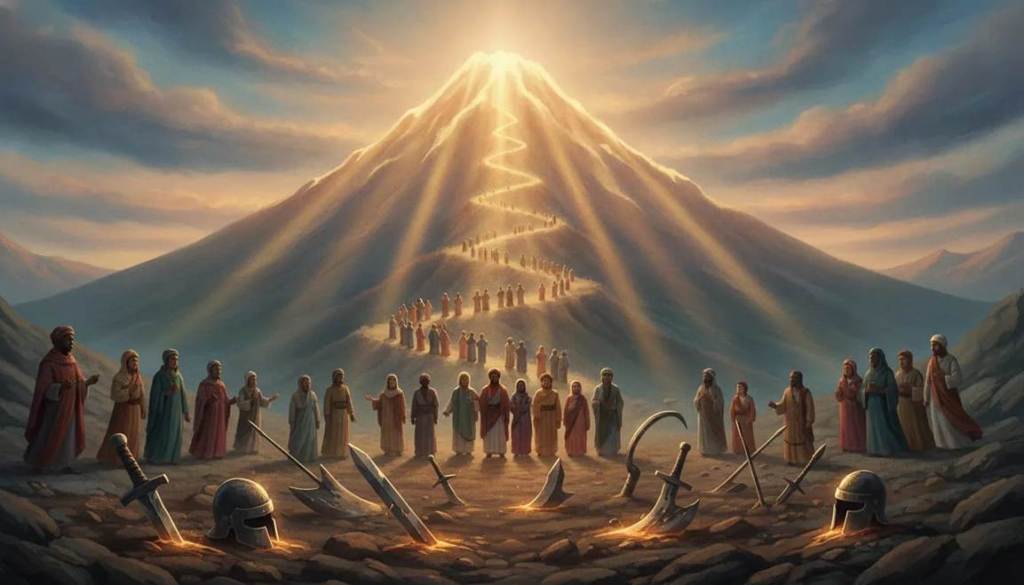
Isaiah 2:1-5 gives one of Scripture’s most memorable pictures of hope: nations coming to God for instruction, weapons becoming farm tools, and people learning war no more. But the passage also raises significant questions. What are the “last days”? Is Mount Zion a literal location? Has this prophecy begun, or is it entirely future?
This passage is a vision of the Messiah’s kingdom, the worldwide spread of true worship, and the transforming power of God’s Word. It is not an excuse for passive optimism. It is a summons to walk faithfully in the light of the Lord.
Key Takeaways
- The last days began with Christ’s first coming and continue until His return.
- Mount Zion points ultimately to God’s worshiping people under the new covenant.
- Christ advances His kingdom among the nations through the gospel and God’s Word.
- Isaiah’s promise of peace calls Christians to hopeful, active, and faithful obedience.
What Does Isaiah 2:1-5 Say?
Isaiah’s prophecy concerns Judah and Jerusalem, but its horizon is far wider than ancient Judah. In the latter days, the mountain of the Lord’s house will be exalted above the mountains. Nations will come to it, seeking to learn God’s ways and walk in His paths.
The result is striking. God judges between nations, settles disputes, and brings an end to the normal patterns of conquest and bloodshed. Swords are reshaped into plowshares, and spears into pruning hooks.
The vision closes with an immediate command: “Let us walk in the light of the Lord.” The promised future is meant to shape present obedience.
Isaiah 2 Is About More Than Judgment
Judgment is a major theme in Isaiah, particularly because Judah had abandoned faithful worship and persisted in rebellion. Yet judgment is not the final word. Throughout Isaiah, warnings of covenant judgment are repeatedly set alongside promises of cleansing, restoration, and the coming reign of the Messiah.
Isaiah 2 introduces that larger hope. The Lord will not merely expose Judah’s sin. He will establish His worship, gather people from the nations, and make His Word known throughout the earth.
This pattern appears elsewhere in the book. Isaiah speaks of a virgin-born son, a king whose government continually increases, and a restored people living under the righteous rule of God. The darkness is real, but it does not define the destination.
What Are the “Last Days” in Isaiah 2?
The phrase “last days” is essential to interpreting Isaiah 2. From the perspective of the Old Testament prophets, it points to the climactic era of God’s redemptive purposes: the age of the Messiah.
In this reading, the last days are not limited to a short period immediately before the end of the world. They begin with Christ’s first coming and continue until His return. This is sometimes called the period between Christ’s first and second advent.
The New Testament identifies Christ’s coming as the last days
Several New Testament passages use last-days language to describe events already underway in the apostolic age:
- Hebrews 1:1-2 says that God has spoken through His Son “in these last days.”
- Acts 2:16-17 identifies the outpouring of the Holy Spirit at Pentecost as the fulfillment of Joel’s last-days prophecy.
- 1 Peter 1:20 says Christ was revealed in the last times.
- 1 John 2:18 describes the apostolic period as the last hour.
- Jude 17-19 refers to scoffers present in the last time.
These texts do not treat the last days as a remote era still thousands of years away from the first-century church. They locate the messianic age in the arrival, ministry, death, resurrection, ascension, and reign of Jesus Christ.
That means Isaiah 2 should be read as a prophecy of what the Messiah begins to accomplish in history, not merely as a description of a future world after history has ended.
For further reading, see Hebrews 1, Acts 2, and 1 Peter 1.
What Is the Mountain of the Lord’s House?
In Isaiah’s setting, the mountain of the Lord’s house refers to Mount Zion, the place associated with Jerusalem, the temple, sacrifice, and the public worship of God. Mountains and high places were often connected with worship in the ancient world, whether true or false.
Isaiah’s point is not that God’s mountain will become geographically taller than every hill on earth. The image speaks of exaltation. The worship of the true God will be lifted above every rival shrine, false god, and counterfeit religion.
The Lord’s name will not remain confined to one people or one city. As Malachi 1:11 foretells, God’s name will be great among the nations, from the rising of the sun to its setting.
How does Zion apply under the new covenant?
The New Testament develops Zion and Jerusalem beyond their earthly, old-covenant setting. Believers are described as coming to Mount Zion, the city of the living God, and the heavenly Jerusalem in Hebrews 12:18-24.
Likewise, the church is described as God’s dwelling place. The people of God are being built together into a holy temple, with Christ as the cornerstone. In this sense, the Lord’s house is not restricted to a future rebuilt temple or a single earthly city. God dwells among His people.
This helps explain Isaiah’s language. The nations come to Zion as they are brought into the worshiping people of God through faith in Christ.
How Do the Nations “Flow” to God?
Isaiah says that all nations will flow to the mountain of the Lord’s house. The picture is deliberately unusual. Water naturally runs downhill, but the nations are pictured as moving upward to God’s mountain.
The point is that this gathering is God’s work. Rebellious people do not naturally seek the Lord. God draws them out of darkness, turns them from idols, and brings them to worship the living God.
This is exactly the pattern seen in the spread of the gospel. People from every tribe, language, people, and nation are redeemed through Christ’s blood, as described in Revelation 5:9-10.
The conversion of the nations is not accomplished by military force. Christ advances His kingdom through the proclamation of the gospel, the work of His Spirit, and the faithful witness of His church.
Why Does Isaiah 2 Say God’s Law Will Go Forth From Zion?
The nations in Isaiah 2 do not come merely for inspiration or religious ceremony. They come because they want God to teach them His ways. They want to walk in His paths.
That is why the prophecy says that the law and Word of the Lord go forth from Zion. Christ’s kingdom has an ethic. God saves people from sin, but He also instructs them in righteous living.
This does not mean that Christians return to the old covenant sacrificial system. Christ has fulfilled that system. But it does mean that God’s moral instruction is not irrelevant to the people of God. His Word teaches believers how to worship, love their neighbors, pursue justice, govern their households, and live as faithful citizens of Christ’s kingdom.
A church should not be embarrassed by the whole counsel of God. The task is to teach Scripture faithfully, in light of Christ’s completed work and the new covenant.
God’s Word is the instrument of transformation
The gospel does not spread because Christians possess superior force, political leverage, or clever arguments. It spreads because the Word of God is powerful. Faith comes through hearing God’s Word, and God uses that Word to expose sin, call people to repentance, and create new life.
That does not make careful thinking unimportant. It does mean that Christians should not lose confidence in the central instrument God has given them: the faithful proclamation of Christ and His Word.
Will Swords Really Become Plowshares?
Isaiah 2:4 gives the famous image of swords beaten into plowshares and spears into pruning hooks. Instruments made for destruction become tools used for cultivation and fruitful labor.
The passage describes the effect of Messiah’s righteous rule among the nations. As people and peoples come under Christ’s authority, warfare is no longer treated as normal, necessary, or glorious. The nations learn war no more.
This is not a denial that wars, conflict, and persecution continue in the present age. Scripture plainly recognizes ongoing rebellion and opposition. The question is whether Christ’s kingdom is ultimately advancing toward defeat or victory.
Isaiah’s vision gives a definite answer: God’s purpose is peace under the rule of His Messiah. The reign of Christ brings judgment against persistent rebellion, conversion among the nations, and the eventual replacement of violence with peaceful fruitfulness.
Christians should therefore pray for peace, oppose needless bloodshed, and seek the discipling of nations rather than treating war as humanity’s inevitable final condition.
Christ Is Reigning Now
The promise of Isaiah 2 rests on the reign of the Messiah. The New Testament presents Jesus as the risen and ascended king, seated at the Father’s right hand.
Acts 2:29-36 connects Christ’s resurrection and ascension with David’s throne. Jesus is not awaiting a future moment to begin His kingship. He reigns now.
Paul makes a related point in 1 Corinthians 15:20-28. Christ reigns until every enemy has been placed beneath His feet. At His return comes the end, and the final enemy to be destroyed is death itself in the resurrection.
This is why Isaiah 2 gives grounds for durable hope. The kingdom of Christ is not a failed project awaiting rescue. It begins like a mustard seed and works like leaven, but it belongs to the King who has all authority in heaven and on earth.
How Should Christians Respond to Isaiah 2?
Isaiah does not give this vision so that God’s people can speculate about dates, withdraw from public life, or surrender to despair. He gives it to call them to faithful action: “Come, let us walk in the light of the Lord.”
That calling remains practical.
1. Let Scripture interpret present circumstances
It is easy to read prophecy through headlines, cultural decline, or personal fears. But changing events are not the final authority for interpreting God’s promises. Christians should interpret their experience through Scripture, not revise Scripture according to a difficult season.
2. Keep worship central
Isaiah’s vision begins with the exaltation of God’s house. The church’s first duty is not to imitate the world’s methods. It is to worship God faithfully and proclaim His Word without apology.
3. Be salt and light
Christians are called to visible faithfulness. Salt preserves, and light exposes darkness. This does not require hostility, arrogance, or a combative personality. It does require a refusal to dilute truth in order to become acceptable.
4. Make disciples through ordinary obedience
The Great Commission is not fulfilled only by public preaching or overseas missions. It includes the ordinary work of teaching Christ’s commands, raising children in the fear of the Lord, honoring marriage, loving neighbors, and bearing consistent witness in every sphere of life.
5. Do not confuse optimism with passivity
Confidence in Christ’s victory should produce labor, prayer, courage, and perseverance. It is not an excuse to do nothing. God ordinarily advances His kingdom through the faithful obedience of ordinary people.
Common Mistakes When Reading Isaiah 2
Making the passage only about a distant future
Isaiah’s prophecy certainly reaches toward the final victory of Christ. But the New Testament’s use of “last days” indicates that the messianic fulfillment began with Christ’s first coming. The kingdom’s growth is already underway.
Reducing salvation to private spirituality
God saves individual people, but Isaiah 2 speaks of nations, worship, justice, peace, and public obedience. The gospel changes hearts, and changed hearts inevitably affect households, communities, and cultures.
Treating God’s law as an embarrassment
The nations come to receive God’s instruction. The law of the Lord is not presented as an obstacle to the kingdom’s advance. It is part of the teaching by which people learn God’s ways and walk in His paths.
Expecting Christ’s kingdom to advance by coercion
The nations are not discipled through carnal weapons. The central means of Christ’s conquest is the gospel. He changes rebels into worshipers by His Word and Spirit.
Giving up because the present is difficult
Isaiah spoke into a time of serious covenant unfaithfulness. The future promise did not minimize Judah’s sin, but neither did Judah’s sin cancel God’s purpose. Faithful people have reason to endure because the Lord remains sovereign over history.
The Point of Isaiah 2
Isaiah 2 presents a world-changing promise: Christ’s kingdom will exalt the worship of the true God, gather people from the nations, teach them the Word of the Lord, and establish peace under His righteous rule.
The proper response is neither panic nor escapism. It is faithful worship, clear teaching, patient discipleship, and confident obedience. The gospel that brought former rebels into God’s people is still the gospel by which Christ advances His kingdom among the nations.
Frequently Asked Questions About Isaiah 2
What is the main message of Isaiah 2:1-5?
Isaiah 2 promises that the Messiah’s kingdom will establish true worship among the nations, teach God’s ways, and ultimately bring peace in place of war.
What do the “last days” mean in Isaiah 2?
In this interpretation, the last days are the messianic age that began with Jesus Christ’s first coming and continues until His second coming.
Does Isaiah 2 predict that there will be no more war?
Isaiah 2 foretells the ultimate result of Christ’s rule among the nations: weapons are turned into tools of cultivation, and nations no longer learn war. The prophecy provides a goal and hope for the kingdom’s advance.
What does it mean for the law to go forth from Zion?
It means that God’s people are to make His Word known. Those drawn to Christ are taught God’s ways so that they may walk in faithful obedience.
For full sermon click on the following link: https://youtu.be/AhZaVyyV1nk

