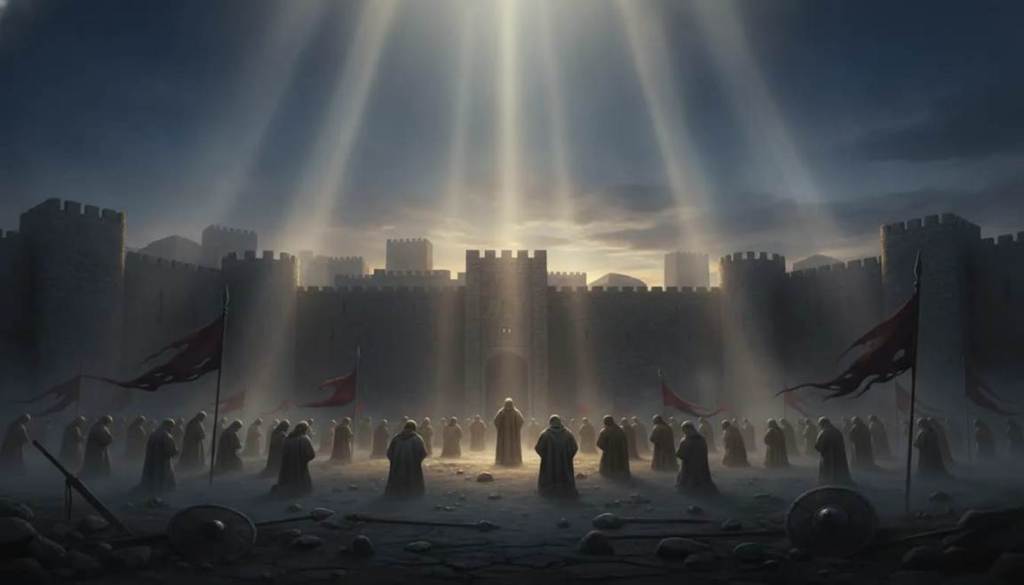
Psalm 76 is a song of praise after a battle that God won. Its central message is plain: God is near to His people, no enemy can withstand His judgment, and human pride ultimately serves to display His glory.
But this is not merely an ancient celebration of military deliverance. Psalm 76 gives God’s people firm ground when threats seem overwhelming. It calls us to fear God rather than powerful people, to remember His faithfulness, and to respond to His protection with worshipful obedience.
Key Takeaways
- Psalm 76 celebrates God’s decisive protection of His people against overwhelming enemies.
- God’s judgment humbles the proud while bringing deliverance to the oppressed.
- Human rage cannot frustrate God’s sovereign purposes or diminish His glory.
- Those who know God should answer His faithfulness with reverence, worship, and obedience.
What Is Psalm 76 About?
Psalm 76 celebrates the Lord as the defender of His people. God is known in Judah, His dwelling is associated with Zion and Jerusalem, and it is there that He breaks the weapons of the enemy. Bows, shields, swords, horses, and chariots all prove useless before Him.
The psalm moves from celebration to awe. God’s victory over a threatening army reveals that He alone deserves fear. When He rises in judgment, the proud are silenced and the oppressed are delivered.
Its final call is practical: God’s people should keep their commitments to Him and bring Him fitting gifts. Even rulers and nations are summoned to recognize the authority of the God they cannot control.
Psalm 76 at a Glance
- God is known among His people. His nearness and revelation distinguish them from the surrounding nations.
- God defeats enemies completely. He disarms both the offensive and defensive strength of the proud.
- God alone is to be feared. No human power can stand when He judges.
- Judgment and deliverance occur together. God’s intervention stops oppressors and rescues the humble.
- Human wrath cannot overturn God’s purpose. Even rebellion is finally brought under His sovereign rule.
- The right response is reverent faithfulness. Those who know God should worship, obey, and fulfill their vows.
Historical Background: Was Psalm 76 Written After Assyria’s Defeat?
Many readers connect Psalm 76 with the deliverance of Jerusalem from the Assyrian army during King Hezekiah’s reign. That event is recorded in 2 Kings 18 and 19 and 2 Chronicles 32.
Assyria had already taken fortified cities in Judah and intended to threaten Jerusalem. Its king, Sennacherib, publicly mocked the Lord and urged Judah not to trust in Him. Hezekiah responded by seeking God, and Isaiah brought the promise of deliverance. The Assyrian force was then destroyed without Judah needing to fight.
This background fits Psalm 76 remarkably well. The psalm describes God breaking weapons near Zion, rendering mighty soldiers helpless, and bringing horses and chariots to a final stillness. The historical account reports that the Lord struck 185,000 Assyrian soldiers in a single night.
There are other views of the psalm’s exact occasion. Some understand it as a prophetic composition associated with Asaph, while others connect it to another deliverance in Judah’s history. The precise date matters less than the main theological point: when God determines to save His people, the strength of their enemies is not decisive.
“In Judah God Is Known”: Why the Opening Matters
Psalm 76 begins with a striking contrast. God is known in Judah, and His name is great in Israel. This is more than saying that Israel had religious information. It means that God had made Himself known to a people He chose, instructed, and drew near to.
All people can see something of God’s power through creation. Romans 1 explains that God’s eternal power and divine nature are evident in what He has made. Yet sinful humanity suppresses that truth rather than giving God the honor He deserves.
Israel received more than this general witness. God gave them His law, covenant promises, worship, and a dwelling place among them. As Psalm 147 emphasizes, God gave His statutes and judgments to Jacob in a distinctive way.
This explains why God’s name was “great” in Israel. His people had seen His promises prove true. They had received His commands, witnessed His works, and been repeatedly reminded that the living God was not distant from them.
God’s Presence Was Israel’s Glory
Psalm 76 also identifies Salem, another name associated with Jerusalem, and Zion as God’s dwelling place. The glory of Zion did not come from geography, military power, or national greatness. It came from the presence of God.
This is why the psalm can speak of Zion as more glorious than hostile “mountains of prey.” Powerful nations may appear high and immovable, especially when they possess fortified cities, trained armies, and a record of conquest. But their apparent greatness is temporary. God’s dwelling among His people is the greater reality.
Israel’s calling was never simply to admire its own privileges. The nearness of God and the righteousness of His law were meant to display His wisdom before the nations. Deuteronomy 4 presents this very pattern: the nations would see God’s wise law and recognize the unique nearness of Israel’s God.
How Does God Win the Battle in Psalm 76?
One of the most important details in Psalm 76 is that God Himself wins the battle. The people do not overcome because they have better strategy, larger numbers, or superior weapons. The Lord acts, and the enemy’s power collapses.
The psalm names the arrows, shield, and sword, showing that neither attack nor defense can survive before God. It then names horses and chariots, the most intimidating instruments of ancient warfare. The point is comprehensive: every source of human confidence fails when God rebukes.
God’s rebuke is not an empty warning. His word accomplishes what He purposes. The army that looked invincible is described as unable to act, as though its strongest men had lost the use of their hands. Those who came expecting to plunder Judah become the plundered.
Overwhelming Circumstances Do Not Limit God
The setting behind Psalm 76 is helpful because Judah’s situation was genuinely desperate. Assyria was not a minor threat. Humanly speaking, Jerusalem was outmatched.
Scripture often places God’s people in circumstances where ordinary strength cannot provide the answer. The Red Sea, Pharaoh’s army, Goliath, and the Assyrian siege all make the same point in different ways: deliverance belongs to the Lord.
This does not mean trouble is evidence that God has abandoned His people. Psalm 76 begins with God’s nearness and then describes war arriving at Zion. God’s people may face opposition while remaining fully within His care.
Why Does Psalm 76 Say God Is to Be Feared?
After describing God’s victory, the psalm asks who can stand when God is angry. The implied answer is no one. The God who silences an army can also judge kings, nations, and every proud human being.
The fear of God in Psalm 76 is not a vague religious feeling. It is the sober recognition that God is holy, just, and completely beyond human resistance. He is not one power among many. He is the Judge before whom every other power must answer.
This is especially significant because the enemy in the historical setting acted with arrogance. Sennacherib’s message was built on the assumption that the Lord could not deliver Jerusalem. That pride was not simply a political miscalculation. It was defiance against God.
The fear of the Lord corrects human pride. It causes people to stop treating earthly strength, wealth, rulers, armies, or personal ability as ultimate sources of security.
Judgment Brings Deliverance for the Oppressed
Psalm 76 holds two truths together: God judges the wicked, and God delivers the oppressed. His judgment is not arbitrary force. He rises to stop oppression and to vindicate those who cannot save themselves.
This pattern runs throughout Scripture. God judged Egypt while bringing Israel out of slavery. He judged Assyria’s arrogance while preserving Jerusalem. His justice is therefore good news for the humble, afflicted, and threatened.
There is also a future-facing dimension. The question of who can stand before God appears again in the Bible’s teaching about final judgment. Revelation 6 depicts kings and mighty people recognizing too late that no social rank or earthly strength can protect them from divine judgment.
What Does “The Wrath of Man Shall Praise You” Mean?
Psalm 76 teaches that human rage does not escape God’s rule. People may act with fury, violence, pride, and hostility toward God’s purposes, but they cannot take history outside His control.
That does not make evil good, and it does not remove human responsibility for sin. The psalm does not praise human wrath as virtuous. Rather, it declares that God is so sovereign that even the rebellion aimed against Him will finally magnify His justice, power, and glory.
Assyria intended to humiliate Judah and dishonor the God of Israel. Instead, its defeat made God’s power known more widely. The very event designed to exalt a proud king became an occasion for the nations to fear the Lord.
This theme is consistent with the wider biblical teaching that God works all things for the good of those who love Him and are called according to His purpose. See Romans 8:28. God does not lose control when wicked people act wickedly.
How Christians Read Psalm 76
Psalm 76 first speaks about God’s protection of Judah and His dwelling in Zion. Christians also see these themes reaching their fullest expression in Christ and His people.
Under the new covenant, God is known by those whom He brings from spiritual darkness into the knowledge of Christ. The church does not replace God’s faithfulness with something unrelated. Rather, Christians understand the promises and patterns of the Old Testament as finding their fulfillment in Christ’s kingdom.
Hebrews 12 speaks of believers coming to Mount Zion, the heavenly Jerusalem, through Jesus, the mediator of the new covenant. The essential glory of Zion remains the same: God is present with His people.
Christ Has Won the Decisive Victory
Psalm 76 pictures God breaking the weapons of hostile powers. Christians see the ultimate victory over sin, death, Satan, and accusation in the cross and resurrection of Jesus Christ.
Christ’s victory was not achieved by His followers overpowering their enemies. He accomplished it by giving Himself and triumphing over the powers opposed to God. This is why Christians can face spiritual conflict with confidence rather than panic.
The New Testament describes believers as equipped with the shield of faith and the sword of the Spirit, which is God’s word. See Ephesians 6. The Christian battle is not permission for violence or pride. It is a call to resist sin, stand in truth, pray, endure, and proclaim the gospel.
The Church Must Not Forget What It Knows
Psalm 76 begins with the blessing of knowing God. Scripture also warns that rejecting this knowledge leads to idolatry and ruin. Israel’s history repeatedly shows the danger of treating God’s revelation as ordinary, optional, or disposable.
This warning remains searching. A person does not remain neutral by refusing to honor God. The heart will attach itself to another ultimate authority, whether that is power, pleasure, wealth, self, ideology, or something else.
For Christians, the response is not complacency. It is to grow in the knowledge of God, obey His word, and remember His works. The fear of the Lord deepens as His character becomes clearer to us.
How Should We Apply Psalm 76 Today?
Psalm 76 is not a promise that Christians will avoid every hardship or that every conflict will end in immediate visible relief. It is a declaration that God remains sovereign, present, and faithful when His people are under pressure.
Here are several practical ways to apply its message.
1. Prepare for trouble before it arrives
Faith is not best built in the middle of a crisis. Psalm 76 gives believers a foundation to establish now. Learn God’s character, remember His past faithfulness, and root your home and church life in His word before circumstances become overwhelming.
2. Fight the right battle
Christians are called to oppose sin in their own lives and to stand against spiritual evil. The first battlefield is not always external. It includes pride, unbelief, bitterness, lust, fear, and every habit that resists Christ’s lordship.
That battle is fought through faith, repentance, prayer, obedience, and the word of God, not self-reliance.
3. Do not overestimate human power
Strong personalities, governments, institutions, cultural pressure, and hostile circumstances can feel final. Psalm 76 refuses that conclusion. God can disarm what appears unbeatable, and He does not need conventional strength in order to save.
4. Fear God more than people
The psalm does not tell us to pretend danger is unreal. Its enemies were real and formidable. But it redirects fear to its proper object. The One who rules over every earthly power is the One who deserves ultimate reverence.
5. Keep your commitments to God
The closing instruction to make vows and fulfill them means that gratitude should become obedience. Christians who confess Christ as Lord should follow through in ordinary faithfulness: worship, prayer, generosity, service, truthfulness, care for fellow believers, and perseverance.
Gifts offered to God are not attempts to purchase protection. They are thankful responses to His grace and greatness.
Common Mistakes When Reading Psalm 76
Assuming the psalm is only about ancient warfare
The historical setting matters, but the psalm reveals enduring truths about God’s sovereignty, justice, holiness, and care for His people. Its message reaches beyond one battlefield.
Using God’s sovereignty to excuse evil
The fact that human wrath ultimately praises God does not make wrath morally acceptable. Proud and violent people remain accountable to God for what they do.
Turning divine protection into a promise of an easy life
God’s people in Scripture often faced danger, opposition, grief, and persecution. Psalm 76 gives confidence in God’s ultimate protection and victory, not a guarantee of comfort in every moment.
Reading spiritual warfare as a call to hate people
The New Testament identifies the Christian struggle as spiritual. Christians are called to love enemies, pursue truth, resist evil, and bear witness to Christ. Human beings are not conquered through hatred but called to repentance and faith.
Final Takeaway
Psalm 76 confronts the illusion that human strength is ultimate. Nations rise, armies gather, rulers boast, and enemies rage. Yet God remains the One who breaks weapons, humbles the proud, delivers the oppressed, and receives the worship He is due.
For those who belong to Him, the right response is steady faith. Know God. Fear Him. Remember His victory. Keep your commitments. And when opposition comes, do not measure the outcome merely by the size of the threat.
Psalm 76 teaches believers to look beyond the battlefield and see the God who stands over it.
Frequently Asked Questions About Psalm 76
What is the main message of Psalm 76?
Psalm 76 teaches that God is near to His people, defeats proud enemies, judges evil, and deserves reverent worship. It assures believers that no human power is beyond God’s authority.
What historical event is Psalm 76 connected to?
Psalm 76 is commonly connected with God’s deliverance of Jerusalem from Sennacherib’s Assyrian army during Hezekiah’s reign, recorded in 2 Kings 18 to 19 and 2 Chronicles 32. Other proposed settings exist, but this connection closely fits the psalm’s imagery.
What does “the wrath of man shall praise you” mean in Psalm 76?
It means that even human rebellion cannot defeat God’s plan. God does not approve of evil, but He sovereignly overrules it so that His justice, power, and glory are ultimately displayed.
What does Psalm 76 teach Christians about spiritual warfare?
Christians are called to resist sin and spiritual evil through faith, prayer, obedience, and God’s word. The psalm points to the confidence that God’s victory is greater than the powers that oppose His people.
For full sermon click on the following link: https://youtu.be/70v-ayN8VuY

