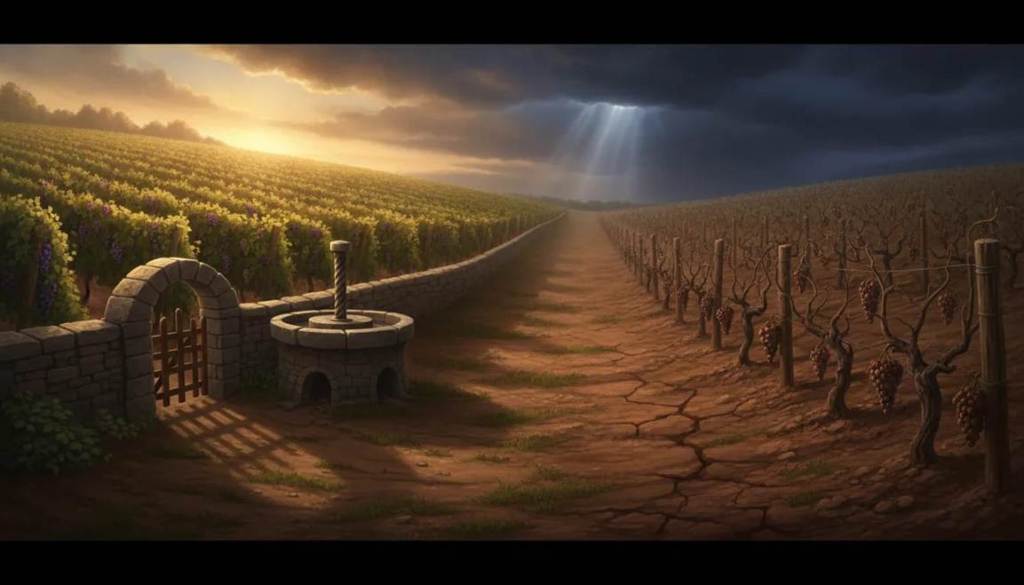
Isaiah 5 opens with a song about a carefully tended vineyard that produces worthless fruit. It is a memorable image, but it is not really about agriculture. The vineyard is Israel, the owner is the Lord, and the bad fruit is a society marked by oppression, unrighteousness, and self-indulgence.
The passage is sobering because it answers a question that remains uncomfortable: What does God expect from people who have received great blessings, clear instruction, and abundant care? Isaiah’s answer is plain. God looks for the fruit of justice and righteousness.
Isaiah 5 is therefore both a warning against covenant unfaithfulness and a call to examine the kind of fruit being produced in our own lives.
Key Takeaways
- Isaiah’s vineyard represents Israel, which received God’s care but produced oppression instead of righteousness.
- The vineyard’s destruction portrays judgment after persistent unfaithfulness, not a failure in God’s provision.
- Isaiah condemns both exploitative greed and drunken self-indulgence as bitter fruit in Judah.
- John 15 identifies Christ as the true vine, the essential source of lasting spiritual fruit.
What Is the Song of the Vineyard in Isaiah 5?
The Song of the Vineyard appears in Isaiah 5:1-7. It begins as what sounds like a song concerning a beloved friend and his vineyard. The setting would have been immediately familiar. A vineyard requires a great deal of labor, foresight, and protection. It does not become fruitful by accident.
The owner chooses a fertile hillside. He prepares the soil, removes stones, plants quality vines, builds a watchtower, and prepares a winepress in expectation of a harvest. Nothing essential has been neglected.
And then comes the turn in the song. Instead of producing good grapes, the vineyard produces wild grapes, meaning fruit that is sour, inferior, and useless for the intended purpose.
The owner asks those listening to judge the case:
What more could reasonably have been done for this vineyard?
That question leaves no room for blaming the owner. The problem is not the location, the preparation, the vine dresser’s neglect, or a lack of provision. The fault lies with the vineyard itself.
The Meaning of the Vineyard Parable
Isaiah does not leave the imagery unexplained. In verse 7, he identifies the vineyard as “the house of Israel,” with the people of Judah as God’s cherished planting.
The main elements of the song can be understood this way:
- The vineyard owner: The Lord of hosts.
- The vineyard: Israel, with Judah particularly in view.
- The fruitful hill: The good land God gave His covenant people.
- The careful cultivation: God’s faithful care, provision, protection, and instruction.
- The expected harvest: Justice and righteousness among God’s people.
- The wild grapes: Oppression and the cries of those suffering under it.
The point is not that Israel lacked privilege. The point is precisely the opposite. Israel had been given much. God had established them, protected them, and supplied what they needed to live as His people. Yet the fruit that appeared in public life did not match the God they professed to serve.
There is a sharp wordplay in Isaiah 5:7. The Lord looked for justice, but found bloodshed and oppression. He looked for righteousness, but heard the cries of victims. The expected fruit was replaced by its ugly counterfeit.
Why Does God Judge the Vineyard?
The judgment described in Isaiah 5 is not arbitrary. The vineyard is judged because it persistently bears the wrong fruit.
The owner removes the hedge and breaks down the wall. The vineyard becomes exposed. It is trampled, overgrown with briars and thorns, left uncultivated, and deprived of rain. In the imagery of the song, the owner does not need to uproot every vine by hand. He removes his protection and leaves the vineyard vulnerable to the consequences of its rebellion.
In Israel’s history, this points forward to national devastation and exile. Judah had trusted in its identity as God’s people while resisting the moral demands of covenant life. But covenant privileges were never meant to be treated as immunity from God’s discipline.
That is a needed correction. Religious language, heritage, prosperity, institutions, and public reputation cannot substitute for obedience. A people may have every external advantage and still bear wild grapes.
The Fruit God Expected: Justice and Righteousness
It is easy to read Isaiah 5 as a general warning about sin and leave it there. But the prophet is more specific than that. God identifies the fruit He was seeking.
He sought:
- Justice: right judgment and fair treatment in the life of the community.
- Righteousness: conduct that conforms to God’s standards.
Instead, He found oppression and heard cries for help. This means that true spiritual health cannot be measured merely by ceremonies, claims, or cultural identity. It shows itself in how people treat their neighbors, especially when wealth, power, land, and pleasure are involved.
Isaiah’s vineyard song presses beyond the question, “What do we say we believe?” It asks, “What does our life together produce?”
The First Woe: Greed That Takes From Others
After the vineyard song, Isaiah 5 moves into a series of woes. These woes expose the particular sins that grew in Judah like bitter fruit.
The first woe falls on those who add house to house and field to field until others have no place left in the land. This is not a condemnation of every purchase, farm, house, or successful business. The issue is covetous acquisition that uses power to force weaker neighbors from what belongs to them.
In Israel, family land was not a disposable abstraction. It was an inheritance. When powerful people accumulated property by exploiting those with less influence, they were not merely making a shrewd transaction. They were violating their neighbor’s household and inheritance.
The contemporary prophet Micah describes the same kind of evil: people devise injustice, covet fields, seize them, and oppress households because they have the power to do so. See Micah 2:1-2.
Ill-Gotten Gain Does Not Produce Lasting Prosperity
Isaiah announces a fitting judgment. The large and beautiful houses gained through unjust means will be left empty. The broad vineyards will yield little. Great effort will produce a meager return.
This follows a basic biblical principle: wealth gained through fraud, oppression, or theft cannot secure lasting blessing. The immediate gain may be real enough, but it is not the same thing as enduring prosperity.
The alternative is not complicated, even if it is costly. Respect your neighbor’s property. Refuse covetousness. Do not use influence, law, or wealth as tools for taking what belongs to someone else. Seek God’s kingdom and pursue an honest life before Him.
The Second Woe: Drunkenness and Deliberate Escape
The next woe addresses those who rise early to pursue strong drink and continue late into the night. Isaiah’s concern is not a passing reference to a meal or ordinary hospitality. He describes a pattern of drunken feasting, self-indulgence, and moral numbness.
Their lives are organized around intoxication and entertainment. Music and wine fill their gatherings, but they give no attention to the work of the Lord or the meaning of His acts.
That is the deeper issue. Drunkenness is presented as a refusal to reckon with reality. Instead of responding to God’s warnings, these people anesthetize themselves. They distract themselves from the fact that sin brings judgment and that their society is already under grave moral strain.
Isaiah’s language is severe because the outcome is severe. The people face captivity, hunger, thirst, death, and humiliation. Their status, pomp, celebration, and pride will not preserve them.
Proverbs gives the same warning in compact form: wine deceives, and strong drink leads people astray. See Proverbs 20:1.
Why Isaiah Connects Intoxication With Spiritual Blindness
People often seek intoxication because they want relief, escape, or forgetfulness. But numbing the mind does not remove the problem being avoided. It only makes a person less able to respond wisely to it.
Isaiah’s concern includes alcohol, but the principle reaches any habit of escape that dulls moral awareness. When a person lives to avoid reality, avoid responsibility, or avoid the claims of God, that pattern cannot produce good fruit.
The answer is not simply stronger willpower. It is repentance, clear-mindedness, humility, and a restored willingness to heed God.
What Does “Sheol Has Enlarged Its Appetite” Mean?
Isaiah 5:14 says that Sheol has widened its appetite and opened its mouth without measure. In this context, Sheol refers to the realm of the dead or the grave. The image is not about ordinary death alone. It portrays widespread death resulting from the judgment coming upon Judah.
The people had celebrated their strength, wealth, and social standing. But God would bring low both the insignificant and the prominent. Human pride would be humbled, while the Lord would be shown holy and exalted in judgment.
This is one of the central themes of Isaiah. God’s holiness is not displayed only in mercy and salvation. It is also displayed when He judges evil rightly.
How Isaiah 5 Connects to Jesus as the True Vine
The vineyard image does not end with Isaiah. Jesus uses closely related imagery in John 15, where He calls Himself the true vine and identifies His followers as branches. The Father is the vine dresser.
Read the passage in John 15:1-11.
The connection matters. Israel’s failure in Isaiah 5 was not due to a lack of divine care. Yet the Old Testament repeatedly records Israel’s inability to produce the covenant faithfulness God required.
In John 15, Christ is presented as the true vine. Fruitfulness comes through abiding in Him. A branch cannot produce fruit by its own independent strength. It lives only as it receives life from the vine.
This does not lessen the seriousness of Isaiah 5. It sharpens it. If God has provided His Son, His Word, prayer, the fellowship of the church, and the work of the Holy Spirit, then fruitlessness cannot finally be blamed on insufficient provision from God.
The question becomes personal: Are we abiding in Christ, or are we trying to produce spiritual life apart from Him?
What Are Wild Grapes in a Christian Life?
Wild grapes are not merely obvious public scandals. They are the bitter fruit produced when people refuse God’s rule while continuing to enjoy His gifts.
In practical terms, wild grapes can include:
- Using money, influence, or position to exploit others.
- Excusing greed as ambition or business success.
- Making pleasure and escape the controlling purpose of life.
- Ignoring injustice while maintaining an outwardly religious identity.
- Blaming circumstances, family, health, or other people for spiritual stagnation.
- Remaining disconnected from Christ while expecting the fruit that only Christ can produce.
Everyone bears something. The contrast is not between people who bear fruit and people who bear none at all. The contrast is between the works of the flesh and the fruit produced by the Spirit.
This is why self-examination is necessary. When God looks for the fruit of righteousness, what will He find? Not what others can observe from a distance, but what is actually being cultivated in the heart and displayed in ordinary conduct.
Common Mistakes When Reading Isaiah 5
Reducing the passage to agriculture
The vineyard details are important because they reveal the owner’s careful labor. But the point is theological and moral. God had cared for His people, and they responded with unfaithfulness.
Assuming judgment means God was unfaithful
The owner’s question settles this issue. Nothing necessary had been withheld. The judgment comes after patient care and persistent bad fruit, not because God failed to provide.
Treating justice as separate from righteousness
Isaiah does not permit a spirituality that is indifferent to the oppression of neighbors. Justice and righteousness belong together in the fruit God seeks.
Applying the woes only to ancient Judah
The historical setting is Judah, and that must remain clear. But the moral warnings are not trapped in the eighth century BC. Greed, oppression, drunkenness, pride, and indifference to God remain bitter fruit wherever they appear.
Thinking external blessings prove God approves
Israel had land, history, worship, and covenant privileges. Those gifts did not excuse rebellion. Blessings should lead to gratitude and obedience, not presumption.
How to Respond to Isaiah 5
Isaiah 5 is meant to do more than make readers condemn the sins of another age. It calls for a response.
- Receive God’s gifts as a stewardship. Every blessing carries responsibility, not entitlement.
- Examine the fruit. Look honestly at conduct, priorities, habits, and the effect your life has on others.
- Reject covetousness and exploitation. Do not build personal gain on the losses of your neighbor.
- Practice clear-mindedness. Refuse patterns of escape that keep you from facing God, sin, and responsibility.
- Abide in Christ. Lasting spiritual fruit is not manufactured through appearances or self-reliance. It grows through living union with the true vine.
- Repent without excuse-making. God’s provision is not deficient. Where sin is present, the proper response is humility and repentance.
Conclusion
The Song of the Vineyard is tragic because the vineyard was loved, prepared, protected, and supplied. It had every reason to bear good fruit. Yet God found oppression where He sought justice and cries of distress where He sought righteousness.
Isaiah 5 warns against presuming on God’s patience or mistaking outward advantage for spiritual health. It also directs us to the only lasting source of fruitfulness. Those who abide in Christ receive life from the true vine and are called to bear the kind of fruit that reflects the character of God.
For full sermon click on the following link: https://youtu.be/wi1nKeHq9Eg

