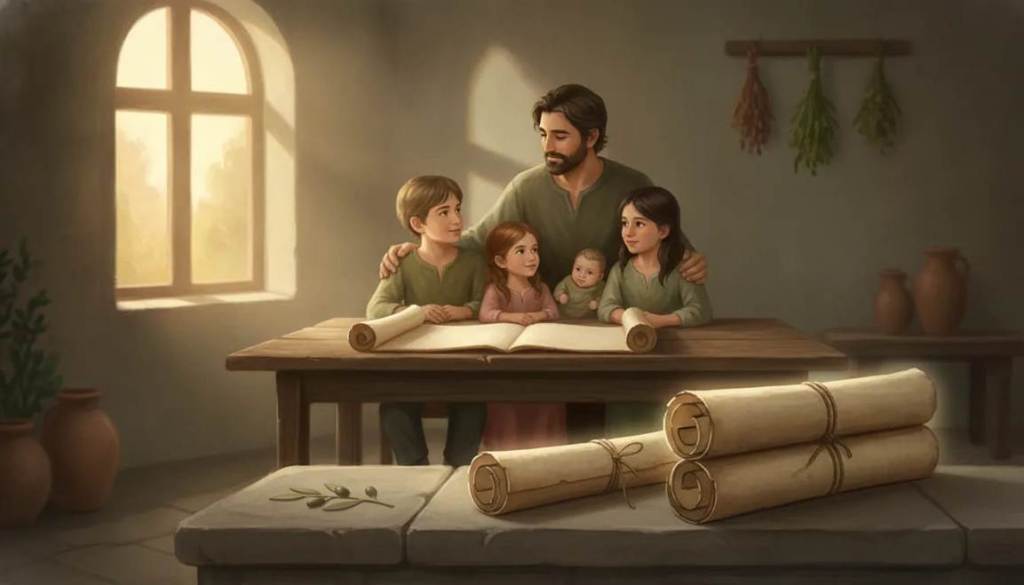
Inheritance is easy to postpone. It can feel like a subject for retirement, a lawyer’s office, or somebody else’s family. But Scripture treats it as a family responsibility that reaches well beyond the distribution of possessions after death.
In Deuteronomy 21:15-17, God gives Israel a case law concerning a father, his sons, and the rights of the firstborn. The immediate question concerns a double portion, but the underlying principle is broader: family resources are a stewardship, and parents should make thoughtful provision for the generation that follows them.
A biblical inheritance includes material goods, certainly. But it also includes wisdom, work habits, faith, instruction, and a living knowledge of God’s Word. A family can be modest in worldly goods and still leave its children exceedingly rich.
Key Takeaways
- Deuteronomy 21 requires parents to handle inheritance with justice rather than favoritism.
- The firstborn’s double portion carried responsibility for service, leadership, and family care.
- Parents should make clear estate plans and train children before entrusting them with resources.
- A lasting inheritance includes material provision, biblical wisdom, faithful work, and spiritual formation.
What Is a Biblical Inheritance?
In the ordinary sense, an inheritance is the legal transfer of a person’s property to those who come after him. In Scripture, it is usually connected to family, household continuity, land, responsibility, and covenant faithfulness.
That means inheritance should not be reduced to a windfall. It is not merely a pile of money dropped into the lap of an unprepared child. At its best, it is the fruit of faithful labor passed on with purpose.
Proverbs 13:22 says that a good man leaves an inheritance to his children’s children. The proverb gives a long horizon. A faithful household does not think only about present comforts. It considers what will strengthen children and grandchildren after it is gone.
This does not mean every family will have the same amount to give. It does mean that parents should think deliberately about what they have been given, what they are building, and how they may bless those entrusted to them.
What Deuteronomy 21 Actually Addresses
Deuteronomy 21:15-17 presents a difficult family situation. A man has two wives, and he prefers one over the other. The firstborn son belongs to the wife he does not prefer. The question is whether the father may bypass that son and give firstborn status to the son of his favored wife.
The answer is no. Personal affection and family favoritism may not overturn the recognized right of the true firstborn. The father must formally acknowledge the firstborn son and give him a double portion of the estate.
This Is a Law About Inheritance, Not an Endorsement of Polygamy
The passage describes a family circumstance, but it does not establish that circumstance as an ideal. Biblical narratives sometimes record practices that are not thereby approved. The foundational pattern for marriage is found in creation: one man and one woman becoming one flesh.
Jesus Himself pointed back to that creation order when teaching about marriage in Matthew 19:4-6. So the point of Deuteronomy 21 is not to create a model for multiple-wife households. It is to establish justice when family circumstances become complicated.
That is worth remembering whenever biblical case laws are studied. A case law gives a judgment in a particular situation. The reader must identify the principle beneath it rather than forcing every detail into a wooden modern replica.
Why the Firstborn Received a Double Portion
The firstborn’s double portion was a legal recognition of rank and responsibility. If a father had four sons, the estate could be divided into five shares, with the firstborn receiving two shares and each remaining son receiving one.
This was not necessarily a reward for being more lovable, more talented, or more successful. Nor was it permission for favoritism. The double portion came with the weight of responsibility.
In many family settings, the eldest son would be best positioned to take up responsibilities after the father’s death. That could include helping care for a widowed mother, younger siblings, dependent family members, or a shared household enterprise. The larger portion was therefore not merely for private consumption. It equipped the recipient for greater service.
There is a straightforward lesson here. When parents give a child greater authority, assets, or opportunity, they should also teach that child greater responsibility. Assets without character can become a curse. Assets joined to maturity, service, and self-government can become a blessing.
Inheritance Should Be Planned, Not Left to Confusion
One of the clearest practical implications of biblical inheritance is that parents should make formal provision for their households. A family should not be left to guess what happens to property, businesses, savings, possessions, or dependents when a parent dies.
In Deuteronomy 21, the father makes his sons inherit what belongs to him. The language assumes an intentional act of distribution. It does not commend delay, vagueness, or a free-for-all among grieving relatives.
In modern terms, this ordinarily means having a clear estate plan appropriate to the family’s circumstances. A will, beneficiary designations, ownership arrangements, and guardianship decisions may all matter. The exact legal documents vary by location and situation, so families should seek qualified local legal and tax advice rather than relying on general assumptions.
Questions Every Married Couple Should Discuss
- What property, accounts, debts, and obligations do we currently have?
- Who would care for our minor children if both parents died?
- Does each spouse understand where important records and documents are kept?
- How would our surviving spouse be protected and supported?
- How do we want resources divided among children and other dependents?
- Are we training our children to handle responsibility before giving them substantial resources?
These are not morbid questions. They are questions of love, foresight, and household order.
A Biblical Inheritance Is Not Limited to the Day of Death
Inheritance is often associated with the reading of a will, but Scripture leaves room for parents to bless children during their own lifetime. The law in Deuteronomy speaks of the day a father causes his sons to inherit, without making death the only possible moment for such provision.
That liberty matters. A child may need help at a key moment: beginning a household, developing useful skills, taking on a family responsibility, or building a productive enterprise. Parents may wisely give at such times, provided the gift is governed by wisdom rather than impulse.
Giving early can also be a form of training. A child who receives a small responsibility while parents are still present can learn to manage it, make mistakes, receive correction, and grow in maturity. That is often better than receiving a large amount after the people most able to give counsel are gone.
Give Opportunity Along With Resources
A healthy inheritance is not simply a transfer of consumption. It can be an opportunity to work, build, serve, and provide. Parents who involve children in honest labor and household responsibilities are preparing them to steward more later.
This need not require a large business or extensive property. It may begin with ordinary work, saving, keeping commitments, caring for tools, serving customers, managing a small task, and learning that productivity is a blessing.
The goal is not to create entitled children. The goal is to raise adults who can receive a blessing without wasting it.
Should Daughters Receive an Inheritance?
Yes. Scripture does not treat daughters as invisible in matters of inheritance. Numbers 27:1-11 addresses the case of Zelophehad’s daughters. Their father died without sons, and the Lord affirmed their claim to receive their father’s inheritance.
The passage also lays out an order of inheritance when there are no sons or daughters, keeping property connected to the wider family. This shows that inheritance was not an incidental matter. It was an important means of preserving household continuity.
Job provides another positive example. After the Lord restored him, Job gave his daughters an inheritance among their brothers, as recorded in Job 42:13-15.
How a family provides for daughters will vary. In the ancient world, a dowry could function as a significant form of provision at marriage. The Bible does not present one mandatory modern formula for every family, but the broad principle is plain: daughters should be thoughtfully cared for, not forgotten.
What if a Child Is Reckless or Untrustworthy?
Inheritance requires wisdom because children do not all mature at the same pace. A parent should not confuse love with enabling destructive behavior.
Scripture gives examples of firstborn privileges being forfeited through serious sin and folly. Reuben lost his preeminence because of his grievous conduct. Esau despised his birthright and traded it away. These examples show that a birthright carried moral weight. It was not a license for rebellion.
Proverbs 17:2 also describes a wise servant sharing in an inheritance while a shameful son is set aside. The proverb does not offer a simple formula for every difficult family. It does show that wisdom, faithfulness, and conduct matter.
When a child is financially reckless, addicted, dishonest, or persistently destructive, parents may need safeguards. Depending on the circumstances, that might involve delayed distributions, oversight by a trustworthy person, limited assistance rather than unrestricted cash, or a plan designed to provide care without financing ruin.
Those decisions require careful judgment, prayer, and often competent legal counsel. The point is not retaliation. It is faithful stewardship.
Do Not Let Favoritism Poison the Family
The particular sin confronted in Deuteronomy 21 is favoritism. The father might have preferred one wife and, by extension, wanted to favor her son. God forbade him from allowing those preferences to overturn justice.
That warning still lands. Parents can be tempted to favor the child who is easiest to relate to, most successful, most flattering, or most like them. Others may be treated as an afterthought.
Such favoritism does not stay hidden. Children often know who is preferred, and unclear or unjust estate decisions can turn longstanding wounds into open conflict after a parent dies.
Jesus warned against covetousness in response to a dispute over inheritance in Luke 12:13-21. Family conflict over an estate may reveal greed in the heirs, but it can also reveal a parent’s failure to give clear and just direction.
Parents cannot control every response after they are gone. They can, however, act with clarity, fairness, and honesty while they are here.
Material Wealth Is Only One Part of the Legacy
Not every parent has land, investments, savings, or a business to pass on. That does not mean such parents have nothing to give. The greatest inheritance is often spiritual.
A father or mother can pass on a knowledge of Scripture, habits of prayer, the ability to work, a love for truth, sound judgment, marital faithfulness, and a pattern of repentance. Those gifts cannot be measured on a balance sheet, but they can shape a household for generations.
Deuteronomy 6 calls parents to teach God’s words diligently to their children in the ordinary rhythms of life: sitting at home, walking along the way, lying down, and rising up. This is not a once-a-week transfer of religious information. It is a household culture shaped by God’s truth.
Parents who do not know how to study Scripture should not settle into embarrassment or pass that uncertainty on. Learning can begin now. Ask for help from a mature Christian, join a Bible study, read carefully, and build the habit of opening the Word with your family.
Material resources may fade. A spiritual inheritance reaches into eternity.
Christ, the Firstborn, and the Greater Inheritance
The firstborn language of Scripture ultimately points beyond family economics. The New Testament repeatedly identifies Jesus Christ as the firstborn, not as though He were a created being, but as the One with supreme rank, authority, and inheritance.
Colossians 1:15-18 calls Christ the firstborn over all creation and the firstborn from the dead. He is the rightful heir, the head of His people, and the risen Lord.
The good news is that those who belong to Christ are not merely distant beneficiaries. Romans 8 says that God’s children are heirs of God and fellow heirs with Christ. Christians receive an inheritance because they have been adopted into the family of God.
That inheritance does not promise an effortless life. Fellowship with Christ includes following Him in faithfulness and suffering as well as sharing in His glory. But it does establish a lasting hope: the Father is good, and He does not abandon His children.
A Practical Biblical Inheritance Checklist
Families do not need to solve every estate question in one evening. But they should begin. A simple, faithful starting point can look like this:
- Take inventory. Identify assets, debts, insurance, accounts, property, and important documents.
- Make a written plan. Use appropriate legal documents rather than leaving major decisions unstated.
- Protect the surviving spouse. Ensure the spouse who remains understands the plan and can carry it out.
- Choose guardians thoughtfully. Parents of minor children should make their wishes clear.
- Consider fairness and responsibility. Avoid favoritism, but recognize that particular responsibilities may require particular provisions.
- Train before transferring. Teach children to work, save, give, serve, and handle responsibility.
- Look for timely opportunities to bless. Consider whether help during life would serve a wise and constructive purpose.
- Build spiritual habits. Read Scripture, pray, repent quickly, and teach children the faith by word and example.
- Review the plan regularly. Marriage, births, deaths, changing assets, and changing laws can all require updates.
Final Thoughts
A biblical view of inheritance begins with stewardship. Everything a household has is received from God, and every parent will eventually give an account for how those resources were used.
That does not require fear or obsession. It calls for clear thought, honest labor, generosity, and a willingness to plan. Families should aim to leave more than possessions. They should leave children who know how to live wisely, work faithfully, serve others, and walk with Christ.
The question is not simply, “What will my children receive from me?” The deeper question is, “What kind of people am I preparing them to become?”
Frequently Asked Questions About Biblical Inheritance
Does the Bible require parents to leave money to their children?
Scripture presents provision for children and future generations as a mark of faithful stewardship. The amount will differ greatly between families, but parents should give thoughtful attention to how they provide materially and spiritually for those who come after them.
Does Deuteronomy 21 require a double portion for the firstborn today?
Deuteronomy 21 establishes the firstborn’s right within Israel’s family law. Its enduring principles include justice, the rejection of favoritism, formal planning, and the connection between greater provision and greater responsibility. Families should apply those principles wisely in their own circumstances.
Can parents give an inheritance before they die?
Yes. Biblical examples support parents blessing children at meaningful points in life. Giving during life may allow parents to provide guidance and to see whether a child is prepared to steward the gift faithfully.
What should parents do if a child is irresponsible with money?
Parents should not ignore serious patterns of destructive behavior. Wise safeguards may be appropriate, including structured support, delayed access, or oversight by a trustworthy person. Such decisions should be made carefully and with qualified legal guidance where needed.
What is the most important inheritance parents can give?
The most lasting inheritance is a spiritual one: a faithful knowledge of God, familiarity with Scripture, habits of repentance and prayer, and an example of love, work, and integrity.
For full sermon click on the following link: https://youtu.be/uSks2M4nee8

