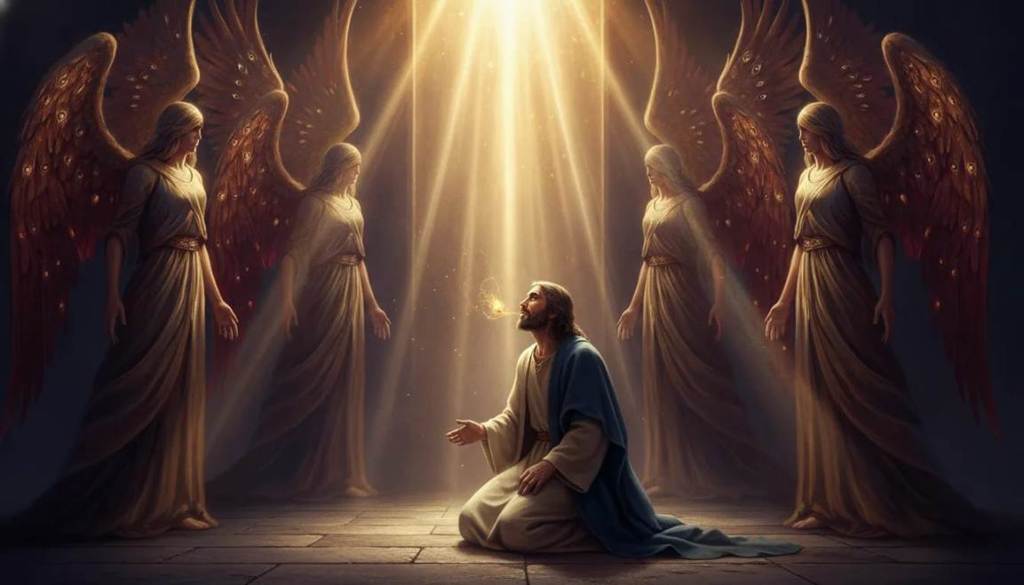
Isaiah 6 tells the story of a prophet sent to speak to people who would largely refuse to listen. Before Isaiah receives that assignment, however, he sees the Lord on His throne, recognizes his own sin, and hears that he has been forgiven.
That order matters. Isaiah’s calling does not begin with confidence in his ability to persuade Judah. It begins with a clearer sight of the God who sends him. The chapter answers not only why Isaiah could speak on God’s behalf, but also how he could remain faithful when the response was painful.
Key Takeaways
- God’s throne remains secure even when Judah’s earthly leadership changes.
- Isaiah confesses his sin before receiving God’s cleansing and commission.
- Isaiah’s task is to speak faithfully, not to control his audience’s response.
- Judgment is severe, but the holy seed leaves room for hope.
Why does Isaiah’s vision begin when King Uzziah dies?
Isaiah dates his vision to “the year that King Uzziah died” (Isaiah 6). This was a significant change for Judah. Uzziah had ruled for decades, and his reign had brought strength and prosperity. Yet his story also carried a warning: after becoming proud, he entered the temple to perform a priestly duty that was not his, and he was struck with leprosy (2 Chronicles 26).
Now that long reign was over. An earthly throne had changed hands, and Judah faced an uncertain future. Isaiah’s first sight in this chapter is therefore a pointed contrast: the Lord is still seated on His throne.
This does not mean Judah’s troubles were imaginary. It means that its king’s death, its spiritual decline, and the threats beyond its borders had not removed God from His place of authority.
What does Isaiah see in the temple?
Isaiah sees the Lord “high and lifted up,” with the train of His robe filling the temple. A king’s robe could display his rank. Here, the image leaves no room for a rival monarch with greater majesty.
Above Him are seraphim, heavenly attendants with six wings each. They use two wings to cover their faces, two to cover their feet, and two to fly. They call to one another, declaring the Lord’s holiness and announcing that His glory fills the earth. Their voices shake the thresholds, and smoke fills the house.
The details build one picture rather than a collection of puzzles to solve. The throne speaks of rule. The robe displays majesty. The seraphim worship with reverence. The shaking and smoke convey the overwhelming presence of God. Isaiah is being shown whom he serves before he is told what he must do.
What does “holy, holy, holy” mean?
The seraphim’s threefold declaration places extraordinary emphasis on God’s holiness. He is not merely better than the people around Him. He is the Creator, distinct from His creation and perfect in all that He is.
Yet the seraphim immediately say that the whole earth is full of His glory. God is not absent from the world over which He reigns. His holiness sets Him apart; His glory is made known throughout His creation. Isaiah will have to speak to Judah about the Holy One of Israel, and this encounter teaches him that the title is no figure of speech.
Why does Isaiah say he is a man of unclean lips?
Isaiah does not respond by congratulating himself on being chosen. He pronounces woe upon himself. In the presence of the holy King, he recognizes that his lips are unclean and that he lives among a people whose lips are unclean as well.
The reference to lips is especially fitting for a prophet. Isaiah is about to become a messenger, yet the very mouth he must use belongs to a sinner. His confession is not that Judah needs correction while he stands above it. He includes himself among the people who need mercy.
Nor is this merely a problem of choosing better words. What comes from a person’s mouth can disclose what is in the heart. Isaiah’s encounter exposes more than an unsuitable speaking habit. It exposes his need to be made fit for God’s service.
There is a necessary lesson here for anyone tempted to treat a calling as proof of personal superiority. Isaiah can speak truthfully to others only after admitting that he, too, needs God’s forgiveness.
How is Isaiah cleansed?
One of the seraphim takes a burning coal from the altar and touches Isaiah’s mouth with it. The seraph then announces that Isaiah’s guilt has been removed and his sin atoned for.
Notice who acts. Isaiah confesses his condition, but he does not cleanse himself. The coal comes from the altar, the place associated with sacrifice, and the assurance of forgiveness is given to him. The vision presents cleansing as God’s provision, not as Isaiah’s achievement.
For Christian readers, the altar also points toward the greater work of atonement accomplished by Jesus Christ. That connection should not erase the immediate force of Isaiah’s experience: at the moment he expects judgment, he receives mercy. Only then does the account move to his commission.
What was Isaiah called to do?
After Isaiah is cleansed, he hears the Lord ask whom He will send. Isaiah offers himself, and God sends him to Judah. The assignment, however, comes with a disturbing warning: the people will keep hearing without understanding and seeing without perceiving.
Isaiah is not promised an eager audience or quick reform. His message will confront an already resistant people, and their continued refusal will be part of the judgment it announces. When Isaiah asks how long this will continue, the answer reaches as far as devastated cities, empty houses, and a desolate land.
This is why the vision of the throne is essential to the chapter. If Isaiah measured the worth of his work only by how many people welcomed his message, his calling would look like failure. But he is responsible for faithfully delivering what God has given him, not for controlling the hearts of those who hear it.
Does the hardening of the people mean there was no hope?
No. The chapter ends with the image of a tree cut down but leaving a stump, identified with a “holy seed.” The judgment is severe, but the final image is not one of complete erasure. God preserves a future for His purposes even after Judah’s apparent collapse.
That tension between judgment and hope continues through Isaiah. The book will not allow readers to dismiss the people’s rebellion. Neither will it allow them to conclude that rebellion has defeated God’s promises.
How does Isaiah 6 connect to Jesus?
The Gospel of John draws directly on Isaiah’s account of hardening when it describes people who did not believe in Jesus despite His signs. John then says that Isaiah spoke as he did because he saw His glory (John 12:37–41).
For Christians, this is a striking connection. Isaiah’s vision is not set aside when Jesus comes. John uses it to help explain both Jesus’ glory and the unbelief He encountered. The rejection of God’s word in Isaiah’s day also prepares readers to understand the rejection of Christ.
What does Isaiah 6 teach about faithful service?
Isaiah’s calling was unusual, but the chapter offers a clear framework for ordinary faithfulness. A parent, a church member, or someone trying to speak honestly about the faith cannot make another person respond well. That does not make their obedience meaningless.
- Begin with God’s character. Circumstances change, but Isaiah’s first assurance was that the Lord still reigned.
- Confess sin rather than claim superiority. Isaiah did not receive permission to look down on the people he was sent to address.
- Receive mercy before taking up the task. His readiness to serve followed God’s cleansing, not an attempt to prove himself worthy.
- Be faithful without pretending to control results. Isaiah had to deliver a hard message even though he knew many would resist it.
There is a mistake on either side of this lesson. One is to treat visible results as the only measure of faithfulness. The other is to use faithfulness as an excuse for carelessness about how we speak and serve. Isaiah was neither promised control over the outcome nor relieved of the responsibility to go and tell the people what God had said.
The point of the vision
Isaiah 6 moves from a throne to a confession, from an altar to a commission. Isaiah sees that God is holy, learns that he cannot make himself clean, receives forgiveness, and is sent into difficult work. The people’s resistance is real, but it is not the deepest reality in the chapter. The holy Lord still reigns, still shows mercy, and still accomplishes His purposes.
For full sermon click on the following link: https://youtu.be/CVGzyE_mB6k

