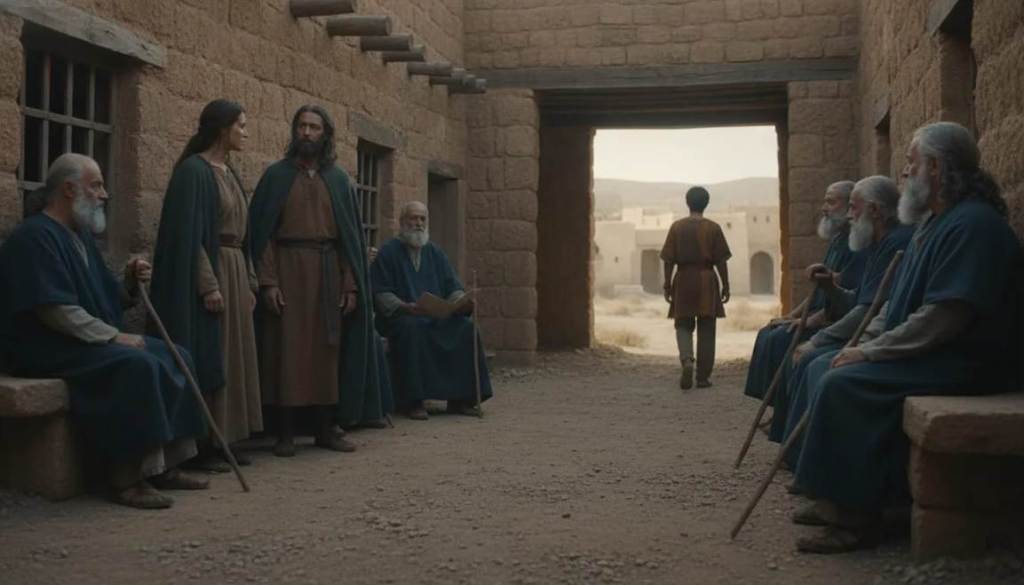
Deuteronomy 21:18-21 is one of the most difficult laws in the Old Testament. It describes parents bringing a stubborn and rebellious son before their town elders. If the charge stands, the men of the town are to put him to death.
That is a severe judgment, and calling it severe is not a failure to take Scripture seriously. The important question is what sort of case the law actually describes. It is not a command to punish a toddler for refusing to cooperate, nor does it give parents permission to harm a child. It concerns persistent rebellion, failed parental correction, and a judgment assigned to Israel’s civil authorities.
What kind of son is described?
The passage calls the son stubborn and rebellious. He refuses to heed either parent, even after they have disciplined him. When the parents state their case to the elders, they add that he lives as a glutton and a drunkard.
Those details belong together. A single argument with a parent would not fit the description. Neither would an ordinary childhood lapse followed by correction. The case concerns a settled pattern of defiance that the parents have tried, unsuccessfully, to address.
The references to gluttony and drunkenness also make a reading about a small child implausible. They describe a life marked by excess and waste, not someone who once ate too much dinner. The passage gives no numerical age, so it is better to describe the son by the conduct in the text than to assign him a precise birthday.
Does the law also mention daughters? No. It presents a case involving a son. The broader command to honor parents applies to sons and daughters alike, but readers should not claim that this particular passage explicitly names both.
Why are both parents and the elders involved?
Deuteronomy names both the father and the mother at each crucial point. The son refuses both their voices, both bring him to the elders, and both testify to his conduct. His mother is not treated as someone whose counsel can be brushed aside. Compare the instruction to heed both father and mother in Proverbs 1:8 and 6:20.
The parents do not carry out a sentence at home. They take the case to the elders at the city gate, where civic matters were heard. The passage is brief and does not spell out every step of a hearing. Still, its distinction between parental accusation and public judgment matters, especially in a capital case. Elsewhere, Deuteronomy requires careful examination of serious charges and rejects conviction on a single witness’s testimony (Deuteronomy 17:4-6; 19:15-18).
So there are two limits worth keeping in view: parents were expected to correct their son, but they did not have the authority to execute him; and an allegation was not meant to be the same thing as an established verdict.
How does this law relate to the fifth commandment?
The fifth commandment tells Israel to honor father and mother (Deuteronomy 5:16). Deuteronomy 21 addresses an extreme violation of that duty. The son’s conduct is not merely a disagreement about household rules. He rejects his parents’ instruction and correction as an ongoing way of life.
The law closes with two stated purposes: to remove evil from among the people and to cause Israel to hear and fear. Within Israel’s covenant law, contempt for parental authority was treated as a matter with consequences beyond one household.
That explains the passage’s seriousness. It does not make the prospect of a family bringing such a charge any less painful. Both points should be allowed to stand.
How should Christians read Deuteronomy 21 today?
Christians can affirm the passage’s moral seriousness without pretending that the question of its present-day civil application is simple. The law was given to Israel with its own civic institutions. Whether, and in what form, its penalty should apply in another society is a further question, not one answered merely by noticing that the fifth commandment still matters.
What can be said plainly is that this passage provides no license for private violence, parental revenge, or treating ordinary teenage conflict as a capital offense. Its procedure places judgment outside the family, and its description sets a far narrower case than “a child who disobeys.”
For Christian households, the New Testament continues to call children to obey and honor their parents. It also warns fathers not to provoke their children and calls them to raise them with instruction (Ephesians 6:1-4). Parental authority is real, but it is not unlimited or exempt from scrutiny.
What should parents and children take from it?
Parents should not read this law and immediately ask how to identify a hopeless child. The case itself says that the parents had already instructed and corrected their son. Before describing a child as unreachable, parents ought to examine whether they have listened, taught, corrected consistently, and taken responsibility for their own conduct. Neglect or cruelty is not vindicated by this passage.
Children and young people should hear the other side of the warning. A habit of dismissing both parents’ counsel is not a harmless route to independence. The command to honor father and mother calls for taking their instruction seriously, even while learning to ask honest questions and exercise growing judgment.
The central mistake is to flatten an exceptional case into an everyday parenting rule. Deuteronomy 21:18-21 addresses entrenched rebellion under Israel’s law. Read carefully, it shows the weight given to parental instruction, the limits of parental power, and the gravity of bringing a charge that no family would want to bring.
Frequently Asked Questions
Does Deuteronomy 21 say to stone disobedient children?
No. It describes a particular case of persistent rebellion despite parental correction, with accusations brought before Israel’s town elders. It does not authorize parents to punish a child whenever the child disobeys.
How old was the rebellious son?
The passage does not give an age. Its description of drunkenness and a sustained pattern of defiance indicates a case very different from the ordinary misbehavior of a young child.
Does honoring parents mean accepting abuse?
No. Deuteronomy 21 does not grant parents unlimited authority or excuse their wrongdoing. A child or young person facing abuse needs protection, not a lecture that treats harmful conduct as legitimate parental discipline.
For full Sermon click on the following link: https://youtu.be/zdgOYRpdBeI

